salakhalimunmountain.com – When the sun dips below the volcanic ridges and the dense canopy light fades into total ink-black darkness, a different kind of light begins to wake up. The magic of bioluminescent fungi in Halimun forest is one of nature’s most surreal spectacles, transforming the damp forest floor into a scene from a fantasy world. In the deep, primary woods of the Halimun sector, where the heavy rainforest air keeps the fallen logs and leaf litter perpetually moist, certain species of mushrooms possess the biological ability to glow with a soft, ethereal neon green light. This living light, known as foxfire, is a silent beckoning to the nocturnal world. As your guide, I want to lead you into the midnight woods—far from the distractions of city lights—to witness how these glowing organisms turn the soft mud trails into a galaxy of terrestrial stars.
The Science Behind the Glow: Cold Light of the Jungle
To truly appreciate the magic of bioluminescent fungi in Halimun forest, one must understand the “cold light” they produce. Unlike a fire or a lightbulb, this glow is a chemical reaction called bioluminescence, involving a substance called luciferin and an enzyme called luciferase. This reaction produces light with almost no heat, a perfect adaptation for the cool, misty environment of the Javanese highlands. While scientists believe this glow might serve to attract insects that help spread fungal spores, for the trekker standing in the middle of a dark grove, it simply feels like pure mountain magic. The glow is most intense during periods of high humidity, making the rainy season the peak time for this luminous display.
The most common glowing species in our park belong to the Mycena genus. These tiny, delicate mushrooms often grow in clusters on decaying bamboo or the fallen branches of Rasamala trees. Individually, they are small, but together they can illuminate a large patch of the forest floor. When you first turn off your headlamp, your eyes need a few minutes to adjust to the darkness of the heavy rainforest air. Slowly, the magic of bioluminescent fungi in Halimun forest reveals itself—tiny, glowing dots and veins appear on the bark and moss covered rocks, creating a map of light that guides you through the shadows of the ancient trees.
A Midnight Trek into the Neon Woods
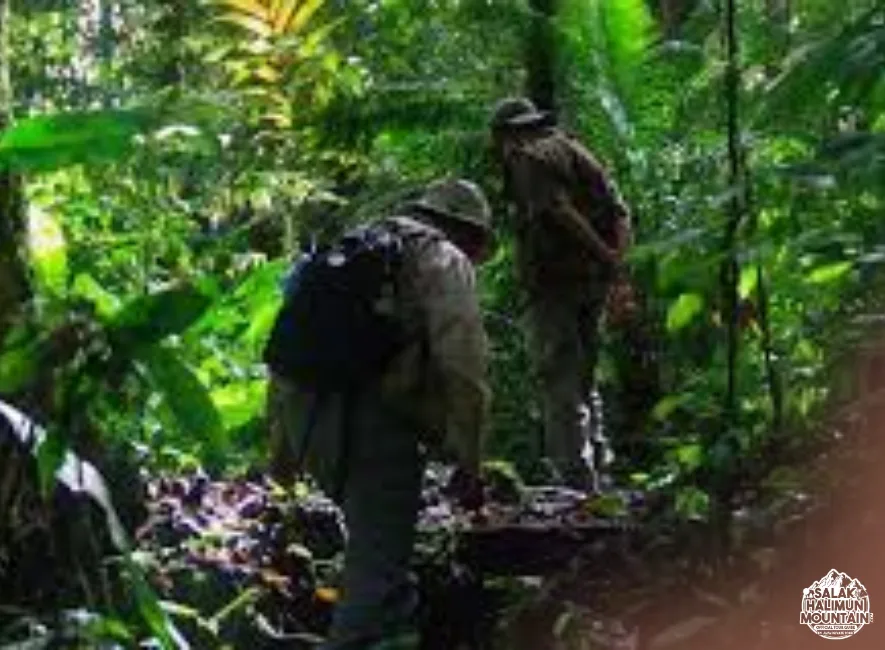
Experiencing the magic of bioluminescent fungi in Halimun forest requires a night trek, usually starting from the Cikaniki or Citalahab research stations. We move slowly along the soft mud trails, guided by the sounds of the night—the call of the Javan Scops Owl and the rustle of nocturnal civets. Once we reach a known “glow zone,” we gather in silence and extinguish all artificial lights. This is the moment when the forest transforms. The glowing fungi act like a natural night-light, highlighting the skeletal structures of fallen leaves and the intricate textures of the forest floor that are invisible during the day.
It is a humbling experience to realize that even in the pitch black, the forest is full of energy and communication. The magic of bioluminescent fungi in Halimun forest reminds us that life in the Halimun Salak National Park is a 24-hour cycle. While the Javan Hawk-Eagle rules the day, these glowing mushrooms dominate the night. This ethereal light provides a rare glimpse into the “hidden” biology of the park, showing us that the most beautiful things are often found in the places where we least expect them, provided we are willing to wait in the dark.
The Ecological Role of the Glowing Mushrooms
Beyond their beauty, the magic of bioluminescent fungi in Halimun forest serves a critical ecological purpose. These fungi are the primary decomposers of the rainforest. They break down the tough lignin and cellulose in dead wood, recycling nutrients back into the volcanic soil to feed the next generation of giant trees. The glow itself is thought to attract nocturnal beetles and flies, which crawl over the mushrooms and inadvertently pick up spores on their legs and bodies. As these insects move through the heavy rainforest air, they act as “postal carriers,” delivering the fungi’s offspring to new locations throughout the park.
This symbiotic relationship between light, insects, and decay is what keeps the Halimun Salak ecosystem vibrant and self-sustaining. When we protect the old-growth areas where these fungi thrive, we are protecting the forest’s cleaning crew. The magic of bioluminescent fungi in Halimun forest is a visible sign of a healthy, functioning primary forest. In areas that have been disturbed or cleared, these sensitive organisms quickly disappear, making their neon glow a “bio-indicator” of the park’s untouched purity. Seeing them is a guarantee that you are standing in one of the most pristine corners of West Java.
Photography Tips: Capturing the Foxfire
Capturing the magic of bioluminescent fungi in Halimun forest on camera is a rewarding challenge for any photographer. Because the light produced is very faint, you will need a tripod and a camera capable of long exposures. We recommend using a wide-aperture lens (f/2.8 or wider) and an ISO setting between 1600 and 3200. Shutter speeds of 20 to 60 seconds are often required to pull the neon green glow out of the darkness. It is a slow, methodical process that requires patience and a steady hand on the moss covered rocks.
Avoid using a flash, as it will wash out the natural bioluminescence. Instead, try “light painting” very subtly with a dim headlamp to bring out the textures of the surrounding wood while keeping the fungi as the main light source. The goal is to capture the contrast between the deep shadows of the heavy rainforest air and the electric green of the mushrooms. When successful, these photos serve as a stunning record of a world that few people ever get to see with their own eyes. They are windows into the secret neon heart of the Mount Salak Halimun wilderness.
Protecting the Glow: Ethical Night Trekking
Because these fungi are so small and delicate, experiencing the magic of bioluminescent fungi in Halimun forest must be done with extreme care. The mycelium—the underground “roots” of the fungi—is easily damaged by trampling. We strictly stay on the soft mud trails and use designated viewing platforms whenever possible. We also limit the size of our night groups to minimize our impact on the nocturnal wildlife. The silence of the night is just as important as the darkness; loud noises can disrupt the feeding and mating patterns of the animals that share the forest with the glowing mushrooms.
We also remind guests to never touch or pick the mushrooms. The magic of bioluminescent fungi in Halimun forest is for the eyes only. Many of these species are quite rare and play a specific role in the local food web. By respecting the “no-touch” rule, we ensure that the next group of trekkers can enjoy the same glowing display and that the forest’s cycle of decay and renewal continues uninterrupted. Being an ethical night trekker means being a ghost in the woods—seeing everything, but leaving the environment exactly as you found it, bathed in its own natural light.
The Cultural Connection: Legends of the Night Light
In the local Sundanese folklore of the mountain communities, the magic of bioluminescent fungi in Halimun forest has often been associated with spirits or “light of the ancestors.” Before the science of bioluminescence was understood, these glowing patches in the dark woods were seen as markers of sacred ground or signs of the mountain’s living spirit. On our treks, we often share these local stories, blending modern science with the ancient myths that have protected these forests for centuries. This cultural layer adds a sense of reverence to the experience, reminding us that we are walking through a landscape that has been respected for generations.
These stories highlight the deep connection between the Kasepuhan people and the “Hidden Mountain.” For them, the forest is not just a collection of trees and animals; it is a sentient entity that speaks through the wind, the mountain mist, and the glowing lights of the night. By witnessing the magic of bioluminescent fungi in Halimun forest, you are following in the footsteps of those who have seen the mountain as a sanctuary for thousands of years. It is a bridge between the physical world and the spiritual, all contained within a tiny, glowing mushroom.
Conclusion: The Forest That Never Sleeps
As we turn our headlamps back on and make our way out of the midnight woods, the image of those glowing green clusters stays with us. The magic of bioluminescent fungi in Halimun forest is a powerful reminder that there is beauty in every corner of the rainforest, even in the dark and the decay. It is the final proof that Mount Salak and Halimun are truly places of wonder, where the rules of the ordinary world don’t always apply. We invite you to join us for a night you will never forget, to breathe the heavy rainforest air in the dark, and to see the forest light up just for you. The stars are not just in the sky; they are under your feet.
So, if you’re ready to explore the wonders of Mount Salak Halimun, head over to our ONLINE BOOKING PAGE and let’s start planning your adventure. Or simply CLICK THIS LINK to chat with us on WhatsApp.
With our team, you’re not just getting a guide; you’re gaining a local friend who will ensure your trip is nothing short of extraordinary.