salakhalimunmountain.com – To see the silhouette of a great raptor soaring against the backdrop of a smoking volcanic crater is to witness the true spirit of the Indonesian wilderness. Understanding why Mount Salak is a sanctuary for Javan Eagles requires looking beyond the beauty of the landscape and into the complex biological requirements of one of the world’s rarest birds of prey. The Javan Hawk-Eagle (Nisaetus bartelsi), known locally as Elang Jawa, is a creature of legend and the inspiration for the national symbol, the Garuda. Here, amidst the heavy rainforest air and the sheer, mist-shrouded ridges, this majestic bird has found a final stronghold. As your guide, I want to show you how the unique geography of the Salak sector—with its ancient trees and thermal currents—creates a perfect environment for this “King of the Sky” to hunt, nest, and raise the next generation of aerial guardians.
The Perfect Architecture of Volcanic Ridges
The primary reason why Mount Salak is a sanctuary for Javan Eagles lies in its dramatic topography. Unlike flatter terrain, the steep volcanic slopes and deep ravines of Mount Salak create powerful thermal updrafts. These rising columns of warm air allow the heavy-bodied Hawk-Eagles to soar and glide for hours with minimal effort, scanning the canopy below for prey. This geological “elevator system” is essential for a large raptor that needs to cover vast territories while conserving energy. From the high vantage points of the Salak ridges, the eagles have an unobstructed view of their kingdom, making it one of the most efficient hunting grounds in the West Javanese highlands.
Furthermore, the jagged cliffs and inaccessible rock faces provide a natural defense. In a world where human encroachment is a constant threat, the “forbidden” nature of Salak’s higher elevations acts as a protective barrier. The eagles can nest in peace, far above the soft mud trails used by trekkers and far from the reach of those who might disturb them. This vertical isolation is a key factor in why Mount Salak is a sanctuary for Javan Eagles; it is a place where the bird remains the undisputed master of the environment, protected by the very mountain it calls home.
The Role of Ancient Rasamala Trees
A sanctuary is only as good as the shelter it provides, and the Altingia excelsa, or Rasamala tree, is the cornerstone of the eagle’s habitat. One of the structural reasons why Mount Salak is a sanctuary for Javan Eagles is the presence of these massive, ancient trees that tower above the rest of the forest. The Javan Hawk-Eagle is a specialized nester that requires the highest branches of the tallest trees to build its large, platform-like nests. These “emergent” trees offer the necessary height to keep the eggs safe from ground predators and provide a clear flight path for the parents to come and go.
The dense canopy light of the Mount Salak forest provides a thick green shield for these nests, keeping them hidden from the eyes of egg thieves and competing raptors. Because the Rasamala is a slow-growing giant, its sturdy branches can support the weight of a nest that is added to year after year. By protecting these ancient trees from logging and clearing, the Halimun Salak National Park ensures that the eagles have a permanent “sky-palace” to return to. The health of the eagle population is a direct reflection of the health of the old-growth forest; where the giants stand, the Garuda soars.
Abundant Prey in the Heavy Rainforest Air
A predator can only thrive where there is plenty to eat, and the rich biodiversity of the Salak sector is a major reason why Mount Salak is a sanctuary for Javan Eagles. The eagle’s diet is incredibly diverse, ranging from small mammals like squirrels and rats to various forest birds and even small reptiles. The heavy rainforest air supports a high biomass of these prey species, ensuring that a pair of eagles can find enough food to support themselves and their demanding chicks. The complex layers of the forest, from the moss covered rocks to the high vines, create a multi-level buffet for a skilled aerial hunter.
Mount Salak’s unique position as a moisture trap means that the forest remains productive year-round. While other areas might face seasonal food shortages, the constant humidity here keeps the cycle of life moving without pause. This reliable food security is a crucial factor in why Mount Salak is a sanctuary for Javan Eagles, particularly during the critical nesting season. An eagle parent needs to know that every hunt will likely be successful to ensure the survival of its single, precious chick. The abundance of the mountain is the fuel that keeps the Garuda’s wings in motion.
Climate and the Mist Factor
Interestingly, the very weather that can make trekking difficult is part of why Mount Salak is a sanctuary for Javan Eagles. The frequent mountain mist and low cloud cover provide a tactical advantage for the Hawk-Eagle. As a “sit-and-wait” predator, the eagle often perches on a hidden branch, using the mist to mask its presence from unsuspecting prey below. The heavy rainforest air muffles sound, allowing the eagle to launch a silent, lightning-fast strike from the shadows. The dynamic weather patterns of Mount Salak play right into the eagle’s evolutionary strengths.
Additionally, the constant moisture ensures that the forest canopy remains dense and opaque. This provides the eagles with the privacy they require for their complex mating rituals and the rearing of their young. The Javan Hawk-Eagle is a notoriously shy bird that does not tolerate human disturbance well. The misty, secluded environment of Salak acts as a natural “Do Not Disturb” sign, allowing the eagles to maintain their wild behaviors in a sanctuary that feels truly untouched by the modern world. In the mist, the eagle finds both its camouflage and its peace.
Conservation Efforts and Local Guardianship
While the mountain provides the physical sanctuary, it is the human effort that keeps it a safe haven. A vital human reason why Mount Salak is a sanctuary for Javan Eagles is the intensive conservation work carried out by the national park authorities and local communities. Since the bird is critically endangered and protected by law, Mount Salak has become a center for monitoring and research. Rangers and local guides act as the “eyes of the mountain,” protecting known nesting sites from poachers and ensuring that tourism remains at a respectful distance.
Local Sundanese communities often hold the eagle in high regard, seeing it as a symbol of the mountain’s power. This cultural respect has translated into a community-based protection network. When you trek with a local guide, you are supporting this guardian system. We educate our guests on how to spot the eagle without causing stress to the bird, promoting a “sight-only” philosophy. This collaboration between the law, the people, and the mountain is the true foundation of why Mount Salak is a sanctuary for Javan Eagles, proving that humans can be the protectors of the wild rather than its destroyers.
Identifying the Garuda in the Wild
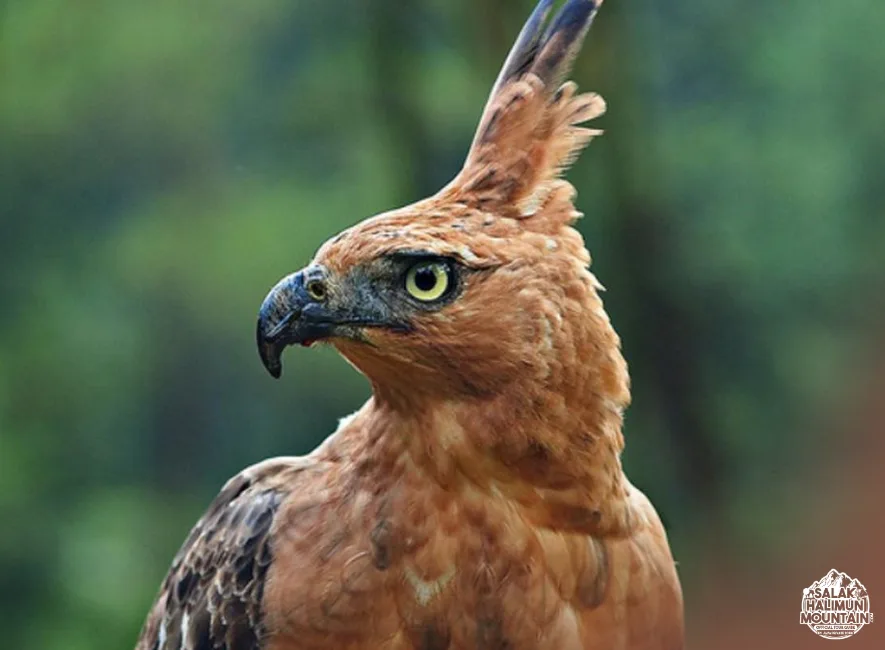
For the lucky trekker, knowing what to look for is part of the experience of understanding why Mount Salak is a sanctuary for Javan Eagles. The Javan Hawk-Eagle is distinguished by its prominent, upright crest of feathers on its head—a feature that gives it a regal, almost crowned appearance. Its plumage is a rich, dark brown on the back with a beautifully barred chest of chestnut and white. In flight, their wings are broad and rounded, perfectly adapted for maneuvering through the ancient trees rather than just open-sky sprinting. Their calls are high-pitched and piercing, often heard before the bird is ever seen.
We often recommend that birdwatchers head to the higher ridges during the early morning hours, when the sun first begins to warm the dense canopy light. This is when the eagles are most active, taking advantage of the first thermals of the day to begin their patrols. Using high-quality binoculars allows you to see the fierce, golden intensity in their eyes—a look that leaves no doubt as to why they are the kings of the West Javanese forest. Seeing one in its natural sanctuary is a privilege that stays with you forever, a connection to a prehistoric majesty that still thrives on Mount Salak.
Ethical Birdwatching and Eagle Safety
To ensure that the mountain remains a sanctuary, we must practice ethical birdwatching. The golden rule of why Mount Salak is a sanctuary for Javan Eagles is that the bird’s well-being always comes first. This means never using “playback” calls to attract their attention and never approaching a nest too closely. Disturbed eagles may abandon their eggs or chicks, which is a tragedy for a species with such low numbers. We always maintain a distance that allows the eagle to continue its natural behavior undisturbed, using long-range optics to bridge the gap.
Staying on the soft mud trails and following the instructions of your guide is essential. The national park has designated certain areas as “core zones” where the eagles are most vulnerable, and we respect these boundaries strictly. By being a responsible observer, you help maintain the integrity of the sanctuary. The goal of our treks is to witness the Garuda in its glory while leaving absolutely no trace of our visit. When the eagle feels safe, it stays—and that is the ultimate goal of our conservation-focused tourism.
Gear for the Aspiring Raptor Spotter
If you are coming to Salak specifically to see why Mount Salak is a sanctuary for Javan Eagles, a few items of gear are indispensable. A pair of 8×42 or 10×42 binoculars is the standard for birdwatching in the heavy rainforest air, providing a clear, bright image even in the shadows. For photographers, a lens with a focal length of at least 400mm is recommended to capture the sharp details of the eagle’s crest and plumage from a safe distance. Because you will be spending time on the ridges, bring a lightweight, windproof jacket, as the mountain air can be chilly even when the sun is out.
A good field guide to the birds of Indonesia will help you distinguish the Javan Hawk-Eagle from other raptors like the Crested Serpent Eagle or the Black Eagle, which also inhabit the park. Most importantly, bring a large amount of patience. The eagle does not work on a human schedule; it belongs to the rhythm of the mountain. Some days you may only hear its cry, while on others, it may soar directly overhead. It is this unpredictability that makes every sighting a true gift from the mountain. The wait is always worth it when the Garuda finally makes its appearance.
Conclusion: The Enduring Legacy of the Sky King
As we look up at the towering peaks of Mount Salak, we are reminded that we are guests in a kingdom that belongs to the eagle. The reasons why Mount Salak is a sanctuary for Javan Eagles are many—from its thermal winds and ancient trees to the dedication of its human protectors—but they all point to one truth: this mountain is a sacred space for the wild. We invite you to come and breathe the heavy rainforest air, to stand on the moss covered rocks, and to look to the sky. The Garuda is still there, soaring on the winds of Salak, a living symbol of hope and natural majesty. Come and see why this sanctuary must be protected forever.
So, if you’re ready to explore the wonders of Mount Salak Halimun, head over to our ONLINE BOOKING PAGE and let’s start planning your adventure. Or simply CLICK THIS LINK to chat with us on WhatsApp.
With our team, you’re not just getting a guide; you’re gaining a local friend who will ensure your trip is nothing short of extraordinary.