salakhalimunmountain.com – when mist curls slowly through the ancient trees of Mount Salak, locals say it is the mountain breathing. In Sundanese belief, this forest has never been empty. It has always been a place of presence, memory, and transformation. Among all the stories whispered beneath its dense canopy, none is as deeply rooted as the legend of Prabu Siliwangi and the white tiger.
This is not a tale of fear. It is a story of choice, dignity, and spiritual ascent. To understand it, one must listen as the forest listens, patiently and without judgment.
Who Was Prabu Siliwangi in Sundanese Memory
Prabu Siliwangi is remembered as one of the greatest kings of the ancient Kingdom of Padjadjaran. In Sundanese oral tradition, he represents wisdom, balance, and leadership rooted in harmony with nature. Unlike historical figures preserved only in stone or text, Prabu Siliwangi lives on through story, song, and belief.
He is not portrayed as a conqueror driven by ambition, but as a ruler who understood limits. His power came not from domination, but from restraint. This distinction is essential to understanding why his story ends not in battle, but in the forest.
As Islam began to spread across Java, Padjadjaran faced immense cultural change. Prabu Siliwangi’s son, Kian Santang, embraced the new faith and sought to persuade his father to follow. What followed was not simply a political conflict, but a spiritual crossroads.
The Encounter Between Prabu Siliwangi and Kian Santang
In many versions of the legend, Kian Santang confronts his father with conviction and urgency. He believes transformation must be immediate. Prabu Siliwangi, however, chooses another path. Rather than submit or fight, he withdraws.
This withdrawal is often misunderstood as defeat. In Sundanese cosmology, it is the opposite. Retreat into the forest is an act of sovereignty. It is the choice to step away from worldly conflict and return to the deeper order of nature.
Mount Salak becomes the setting for this decision. Its dense rainforest, hidden valleys, and constant mist form the perfect threshold between the human realm and the spiritual one.
The Transformation Into the White Tiger
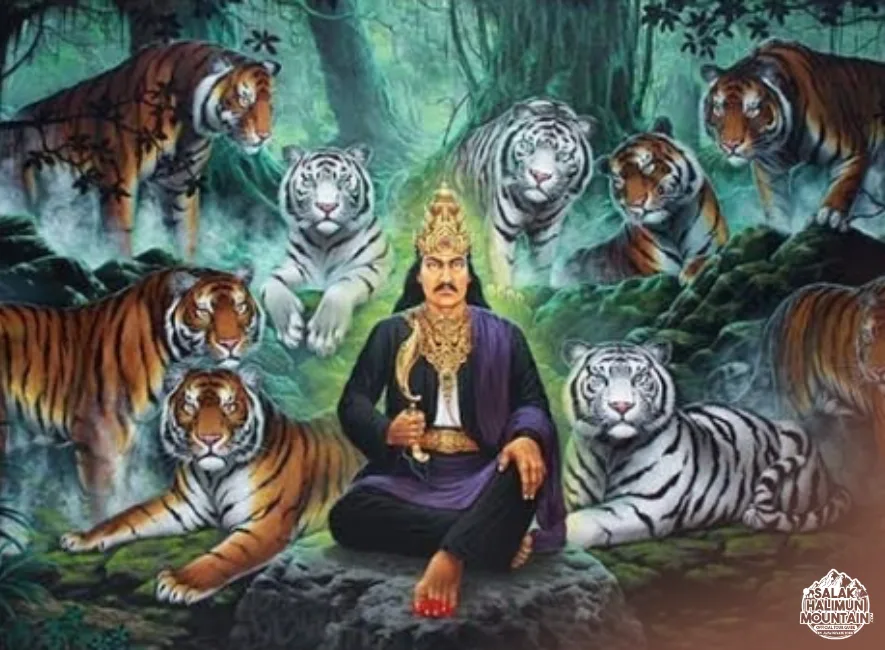
The most powerful element of this legend is Prabu Siliwangi’s transformation into a white tiger, known locally as harimau putih. This is not a curse. It is an ascension.
In Sundanese belief, the tiger symbolizes guardianship, authority, and balance. The white tiger, in particular, represents purity of intention and spiritual mastery. It is believed that Prabu Siliwangi did not physically become an animal, but spiritually merged with the guardian force of the forest.
By becoming the white tiger, he remains present without ruling. He protects without commanding. He watches without interfering. This form allows him to guard the land eternally, free from the burdens of the human world.
Mount Salak as a Place of Spiritual Withdrawal
Forests in Sundanese tradition are not places to escape responsibility. They are places to return to essence. Mount Salak, with its rugged terrain and deep silence, is seen as ideal for spiritual withdrawal.
Even today, the mountain feels introspective. Trails disappear into thick undergrowth. The air is heavy with moisture. Sound becomes layered and distant. It is easy to feel small here, and that is precisely the point.
Prabu Siliwangi’s choice to enter this forest reflects a belief that true power lies in knowing when to step aside. In doing so, he becomes part of the mountain’s consciousness, a guardian rather than a ruler.
The Meaning of the White Tiger in Sundanese Belief
The white tiger is not associated with aggression. It is associated with vigilance. In many households across West Java, stories of the harimau putih are told as reminders of moral boundaries.
To encounter the white tiger is not necessarily to see it with the eyes. It may be felt as a sudden stillness, a sense of being observed, or an unexpected calm during moments of danger. These experiences are interpreted as guidance, not threat.
Within Mount Salak, the white tiger symbolizes the spirit that keeps balance. When humans act with humility, the forest remains generous. When arrogance appears, the forest becomes difficult.
Why Forests Are Places of Ascension, Not Escape
In many modern narratives, forests are depicted as places to flee from society. In Sundanese cosmology, they are places to grow beyond it. Ascension does not mean leaving the world behind, but understanding it more deeply.
Prabu Siliwangi’s transformation reflects this belief. By withdrawing into Mount Salak, he does not disappear. He becomes more present in a different form. His story teaches that endings can also be continuations.
This worldview shapes how locals interact with the forest today. Entry is accompanied by intention. Movement is measured. Silence is respected. These practices echo the ancient understanding that the forest is a teacher.
Modern Beliefs and Encounters With the Harimau Putih
Even in modern times, stories persist of encounters linked to the white tiger. Hikers speak of being guided away from danger by sudden instincts. Farmers tell of feeling watched while remaining unharmed. Elders speak of signs rather than sightings.
These stories are rarely dramatic. They are quiet. Subtle. Often shared in hushed voices after sunset. Their consistency across generations reinforces the belief that Mount Salak is still under guardianship.
Importantly, such stories are not used to frighten visitors. They serve as reminders to behave respectfully, to understand limits, and to recognize that the forest responds to human presence.
Gunung Salak Folklore as Living Guidance
Folklore surrounding Prabu Siliwangi is not frozen in the past. It evolves with the community. Each retelling adapts to contemporary life while preserving core values of humility, balance, and respect.
By framing Prabu Siliwangi as a guardian rather than a defeated king, Sundanese culture reinforces the idea that leadership can exist without control. This message remains relevant in a world increasingly disconnected from nature.
Walking Mount Salak With the Story in Mind
For visitors to Mount Salak, understanding this legend changes the experience. Trails become more than routes. Silence becomes meaningful. The forest feels less like an obstacle and more like a companion.
Walking here is not about conquering summits. It is about moving through a living story. Each step echoes with memory. Each pause invites reflection.
Respecting the Legacy of Prabu Siliwangi Today
Respecting this legend means respecting the mountain itself. Staying on paths. Avoiding loud behavior. Acknowledging local customs. These actions keep the relationship between humans and forest in balance.
Prabu Siliwangi’s legacy lives on not through monuments, but through how people treat Mount Salak. In this way, the white tiger continues to watch, unseen but present.
So, if you’re ready to explore the wonders of Mount Salak Halimun, head over to our ONLINE BOOKING PAGE and let’s start planning your adventure. Or simply CLICK THIS LINK to chat with us on WhatsApp.
With our team, you’re not just getting a guide; you’re gaining a local friend who will ensure your trip is nothing short of extraordinary.