salakhalimunmountain.com – When you look up from the forest floor in the heart of Halimun Salak National Park, you are not just looking at a collection of trees. You are peering into a vertical city, a complex and tiered world where life is stacked in layers reaching toward the sun. To the untrained eye, the rainforest might look like a chaotic wall of green, but for those of us who walk these paths every day, the structure is clear and rhythmic. The rainforest canopy layers explained for travelers is a journey from the dark, damp earth to the sun-drenched heights of the giants. Each layer has its own climate, its own residents, and its own secrets, and understanding this structure will completely change the way you experience your next trek through the mountains of Salak and Halimun.
The Forest Floor The Foundation of Life
The Dark and Humid Underworld
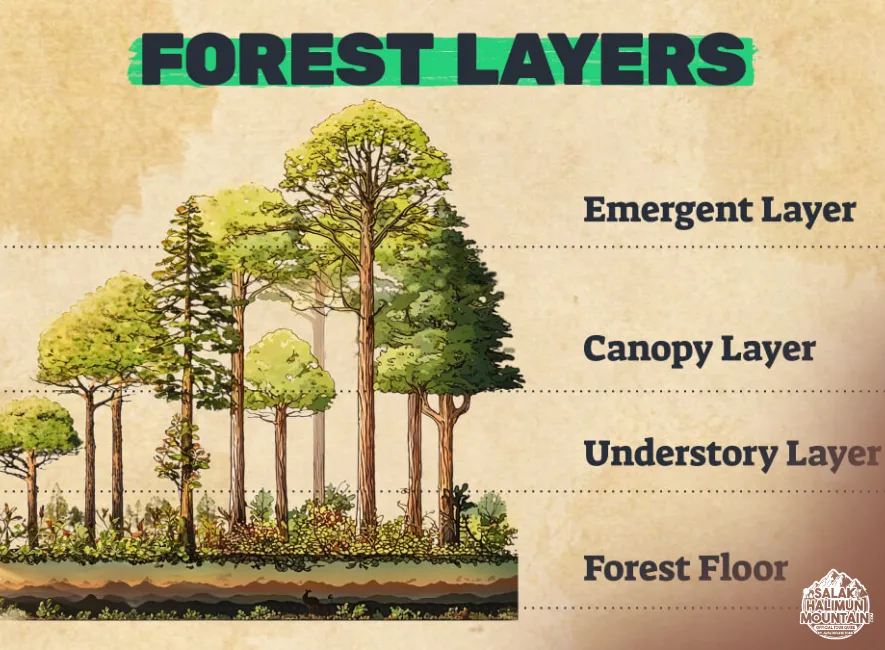
The journey begins at your boots. The forest floor is the first layer, and it is a place of shadows and recycling. Because the layers above are so thick, only about two percent of sunlight ever reaches this level. This creates a unique environment where heat and humidity are trapped, feeling almost like a natural sauna. Here, the air is still and carries the heavy, sweet scent of damp earth and decaying leaves. This is where the great cleanup happens; fungi, leaf litter, and microscopic organisms work tirelessly to break down organic matter into nutrients. For the traveler, this is where you will spot the intricate root systems of the Rasamala trees and the delicate mosses that carpet the volcanic rocks of Mount Salak.
Wildlife of the Shadows
While most of the park’s famous inhabitants live higher up, the forest floor is far from empty. This is the realm of the elusive Javan Leopard, who moves through the undergrowth with silent precision. It is also where you will find exotic insects, colorful land snails, and the occasional forest dragon lizard blending into the bark. When we guide guests through this layer, we encourage a slow pace and a quiet voice. By looking closely at the ground, you might see the tracks of a wild boar or the tiny path of a forest crab near a stream. It is a world of micro-details that tells the story of the forest’s health and vitality.
The Understory Layer The Realm of Shadows
Survival in the Dappled Light
Just above the forest floor, reaching up to about twenty meters, is the understory. This layer consists of young trees, shrubs, and large-leafed plants like wild ginger and ferns that have adapted to low light. The leaves here are often exceptionally large, designed like solar panels to catch every stray beam of light that filters through the canopy. The air in the understory is slightly more buoyant than on the floor, but it remains very humid. For the trekker, this is the layer that provides the “jungle feel,” where vines like lianas hang from above and the vegetation is thickest along the sides of the trail. Walking through the understory toward a hidden Halimun waterfall is an immersive experience in deep green hues.
The Sound of the Understory
This is where the acoustic life of the rainforest really begins to hum. Many of the park’s birds, like the vibrant Javan Kingfisher or various flycatchers, flit through these lower branches. It is also the favorite haunt of the Javan Lutung, or ebony leaf monkey, who often sits in the understory trees to feed on young leaves. Because the vegetation is so dense here, animals often rely on sound rather than sight to communicate. As a traveler, learning to identify the different rustles and chirps in the understory is like learning a new language. Our guides love to point out these hidden interactions, showing you how a seemingly still bush might actually be a busy foraging site for a family of forest birds.
The Canopy Layer The Green Machine
The Engine of the Rainforest
The canopy is the most famous part of the forest, forming a continuous roof of greenery roughly thirty to forty meters above the ground. This is the primary engine of the Mount Salak ecosystem. It is here that the majority of photosynthesis happens, and it is also where the highest concentration of biodiversity lives. The canopy acts as a giant umbrella, protecting the layers below from the intense tropical sun and the heavy impact of monsoon rains. Because it is so rich in fruits, seeds, and flowers, the canopy is a non-stop buffet for the forest’s residents. In Salak Halimun, this is the prime territory for the Owa Jawa, or Javan Gibbon, whose acrobatic displays in the high branches are a highlight of any expedition.
Life Among the Branches
For a traveler, seeing the canopy usually requires looking up through the “windows” in the trees, but the experience is spectacular. The canopy is home to epiphytes—plants like orchids and ferns that grow on the branches of taller trees to reach the light. These aerial gardens create their own mini-ecosystems, holding pools of water that support insects and frogs high above the ground. The competition for space and light in the canopy is fierce, resulting in a dizzying array of life. When the morning mist clings to the canopy ridges of Mount Halimun, it looks like a lost world from another time. It is a place of constant movement, where the wind whistles through the leaves and the sun plays hide and seek with the forest floor below.
The Emergent Layer The Giants of the Clouds
Breaking Through to the Sky
Finally, we reach the emergent layer. These are the true giants of the Salak Halimun rainforest—individual trees that have grown so tall they have broken through the canopy to tower over everything else. These trees can reach heights of sixty meters or more. Living in the emergent layer is a challenge; these trees are exposed to the strongest winds, the hottest sun, and the most direct rain. To survive, they often have small, waxy leaves that resist drying out. From the perspective of a trekker standing on a high ridge or at a lookout point, seeing the emergent trees rise above the green sea of the canopy is a humbling sight. They look like sentinels guarding the mountain peaks.
The Domain of the Great Eagles
The emergent layer is the exclusive domain of the masters of the sky. The Javan Hawk Eagle, the national bird of Indonesia and a symbol of conservation, often nests in the highest branches of these emergent trees. From these vantage points, they can scan the valleys for prey and launch into the air with ease. Seeing one of these magnificent birds soaring above the forest giants is a rare and powerful experience. This layer represents the untamed spirit of the park—a place where the earth truly meets the sky. It reminds us that there are still places in the world that remain wild and majestic, far above the reach of human interference.
Why Vertical Diversity Matters for the Traveler
A Richer Trekking Experience
Understanding these layers changes how you walk through the park. Instead of just seeing “the forest,” you begin to see the different neighborhoods and the residents that belong to each. You realize that a movement in the understory is likely a different animal than a movement in the high canopy. This knowledge makes the trek more engaging and rewarding. Whether you are interested in photography, birdwatching, or simply soaking in the atmosphere, being aware of the vertical structure of the rainforest allows you to connect with the landscape on a much deeper level. It turns a simple walk into an educational adventure through one of the most biodiverse places on earth.
The Importance of Canopy Conservation
Every layer of the rainforest is interconnected. If the emergent trees are lost, the canopy is exposed; if the canopy is thinned, the forest floor dries out and the cycle of nutrients is broken. By understanding the complexity of these layers, our guests often gain a newfound respect for conservation efforts. Protecting Halimun Salak National Park means protecting this entire vertical city from the roots to the highest leaves. When you choose to trek with a responsible local guide, you are helping to ensure that this multi-layered masterpiece remains intact for generations to come. The rainforest is a gift, and its layers are the wrapping that keeps the magic of Mount Salak alive.
So, if you’re ready to explore the wonders of Mount Salak Halimun, head over to our ONLINE BOOKING PAGE and let’s start planning your adventure. Or simply CLICK THIS LINK to chat with us on WhatsApp.
With our team, you’re not just getting a guide; you’re gaining a local friend who will ensure your trip is nothing short of extraordinary.