salakhalimunmountain.com – To truly understand the “Hidden Mountain,” you must be willing to look at the world on a miniature scale. While the towering volcanic peaks and ancient trees often grab the headlines, the secret life of moss in misty Halimun forest is the quiet foundation upon which this entire ecosystem is built. In the Halimun sector, where the clouds frequently descend to touch the ridges, a soft, emerald carpet covers every available surface—from the gnarled bark of the Rasamala to the jagged volcanic stones. This is the realm of the bryophytes, a prehistoric lineage of plants that thrives in the heavy rainforest air. As your guide, I invite you to slow your pace, leave the distractions of the modern world behind, and discover how these tiny green forests-within-a-forest hold the key to the mountain’s survival and its most enchanting mysteries.
The Emerald Sponge of the Highlands
The secret life of moss in misty Halimun forest is defined by its incredible ability to manage water. In a region that receives some of the highest rainfall in Java, these mosses act as a massive, living sponge. They capture the moisture from the passing mountain mist and the frequent tropical downpours, preventing the soft mud trails from washing away and ensuring a steady flow of water into the streams below. When you press your hand against a thick cushion of moss on a fallen log, you can feel the cool, stored life-force of the rainforest. This water retention is vital during the short dry season, providing a micro-refuge for countless smaller organisms that would otherwise perish without constant humidity.
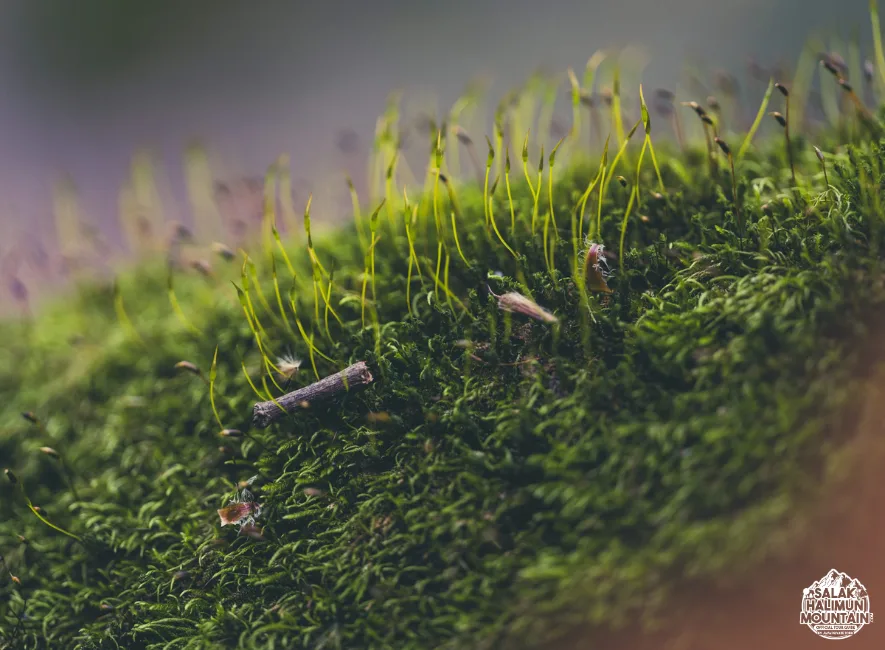
There are hundreds of species of moss in Halimun Salak, each with its own unique texture and shade of green. Some resemble tiny ferns, while others look like miniature pine trees or delicate velvet ribbons. Because they lack traditional roots, they absorb nutrients and water directly through their leaves, making them highly sensitive to the quality of the heavy rainforest air. Their lush presence is a biological indicator of an environment that remains pure and undisturbed. Exploring these mossy banks is like walking through a gallery of natural lace, where the dense canopy light filters through the trees to highlight the intricate patterns of a world that most people simply walk past.
A Sanctuary for Micro-Wildlife
If you look closely at a patch of moss with a magnifying glass, you will realize that the secret life of moss in misty Halimun forest is actually a bustling metropolis. These green carpets provide a complex habitat for a variety of microscopic and small wildlife. Rare forest snails, colorful beetles, and tiny amphibians use the moss as both a nursery and a hunting ground. The thick fibers protect them from predators and keep them hydrated in the mountain air. In the Halimun sector, we often find the Javanese tree frog resting on these mossy cushions, its green skin perfectly camouflaged against the bryophyte background.
Even larger animals rely on this “secret life.” Many birds use the soft, insulating fibers of certain mosses to line their nests, ensuring their chicks stay warm in the cool highland nights. The relationship between the moss and the fauna is a perfect example of the interconnectedness of the Halimun Salak ecosystem. Every square inch of moss supports a food web that eventually reaches the top predators of the park. When we protect the moss covered rocks and the ancient trunks they cling to, we are protecting the home of thousands of species that are invisible to the naked eye but essential to the forest’s health.
The Art of Epiphytic Mosses
In the deep primary forest, space is at a premium, and the secret life of moss in misty Halimun forest extends far above the ground. Many mosses are epiphytes, meaning they grow on the branches and trunks of ancient trees rather than in the soil. Over decades, these mosses can grow several inches thick, eventually hosting other plants like rare orchids and ferns. In the Citalahab and Cikaniki regions, the trees are so heavily draped in moss that they appear to have shaggy, green fur. This vertical landscape creates “hanging gardens” that catch nutrients from the heavy rainforest air and falling debris, creating a fertile soil high above the forest floor.
Walking through these moss-draped corridors feels like stepping into a storybook. The moss muffles the sound of your footsteps on the soft mud trails, creating a quiet, reverent atmosphere. The way the dense canopy light plays across the hanging mosses at sunrise is a sight that stays with you long after you leave the mountain. These epiphytic communities are particularly rich in the “Cloud Forest” zones of Mount Halimun, where the humidity is constant. They represent the patience of nature—a slow, steady growth that transforms a bare branch into a thriving, multi-species community over the course of many human lifetimes.
Moss and the Volcanic Landscape
The volcanic history of the area is also intertwined with the secret life of moss in misty Halimun forest. Mosses are often the first “pioneer” species to colonize the barren, moss covered rocks left behind by ancient lava flows or landslides. By growing on the hard stone, they slowly break down the minerals and trap organic matter, eventually creating enough soil for larger plants like ferns and shrubs to take root. In areas near the Kawah Ratu crater, you can see this process in action, as brave patches of green begin to reclaim the scorched earth near the geothermal vents.
This ability to turn rock into soil makes moss a fundamental architect of the landscape. Without these tiny plants, the transition from a volcanic wasteland to a lush rainforest would take significantly longer. In the heavy rainforest air of Halimun, this cycle of renewal is always visible if you know where to look. The mosses are the bridge between the fire of the volcano and the life of the jungle. They remind us that even the smallest life forms have the power to change the world, given enough time and the right conditions. Every mossy ridge is a monument to this quiet, persistent strength.
Conservation of the Misty Undergrowth
Because it is so small and ubiquitous, the secret life of moss in misty Halimun forest is often overlooked in conservation efforts, but it is incredibly vulnerable. Mosses are highly sensitive to “trampling” and changes in micro-climate. When a forest is thinned or a trail is widened, the resulting increase in sunlight and decrease in humidity can cause the moss to dry out and die, leading to soil erosion and the loss of the micro-wildlife that depends on it. This is why we are so passionate about keeping our groups small and staying strictly on the established paths within the national park.
Responsible trekking is the only way to ensure that these emerald carpets remain for the future. We teach our guests to “watch their step” not just for their own safety, but for the safety of the moss. By fostering an appreciation for the secret life of moss in misty Halimun forest, we hope to create a new generation of conservationists who value every part of the ecosystem, from the tallest tree to the smallest spore. The moss is the skin of the mountain; it protects, it breathes, and it heals. Protecting it is a simple but profound act of stewardship that benefits the entire West Javanese watershed.
Photography Tips for the Mossy Wild
Capturing the secret life of moss in misty Halimun forest through a lens requires a different approach than standard landscape photography. To see the true beauty of the bryophytes, you need to get low. We recommend using a macro lens or the macro setting on your phone to capture the “forest-within-a-forest” perspective. The best time for photography is during a light mist or immediately after a rain, when the mosses are fully hydrated and their colors are most vibrant. The way water droplets cling to the mossy fibers like tiny diamonds is one of the most beautiful sights in the Halimun forest.
Pay attention to the dense canopy light. Overcast days are actually better for moss photography because the soft, diffused light prevents harsh shadows and highlights the deep, rich greens. Use a tripod if possible, as the low light levels in the deep woods require longer exposure times to capture the sharp details of the mossy textures. By focusing on these small details, you can tell a much larger story about the health and magic of the Halimun Salak area. Your photos become a record of a hidden world, inviting others to appreciate the subtle wonders that make this mountain so special.
Conclusion: The Quiet Heart of the Mountain
As we reach the end of our journey into the secret life of moss in misty Halimun forest, I hope you have developed a new respect for these humble green giants of the undergrowth. They are the silent workers that keep the mountain green, the water flowing, and the air clean. In the mist of Halimun, the moss reminds us that there is a quiet power in simply existing and providing for others. We invite you to come and walk with us, to breathe the heavy rainforest air, and to witness this emerald magic for yourself. The hidden world is right at your feet, waiting to be discovered.
So, if you’re ready to explore the wonders of Mount Salak Halimun, head over to our ONLINE BOOKING PAGE and let’s start planning your adventure. Or simply CLICK THIS LINK to chat with us on WhatsApp.
With our team, you’re not just getting a guide; you’re gaining a local friend who will ensure your trip is nothing short of extraordinary.