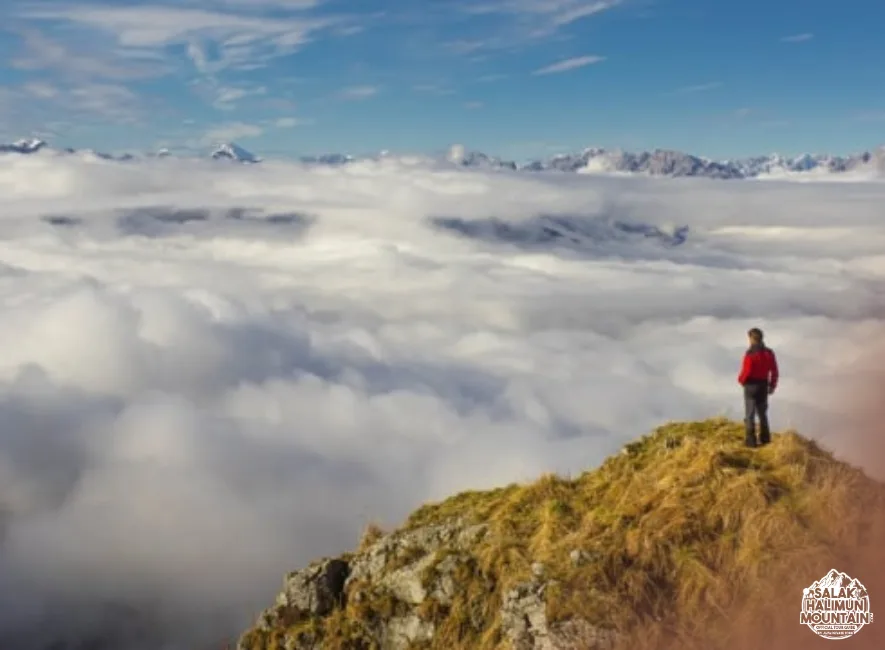
salakhalimunmountain.com – If you’ve ever trekked through Mount Salak or wandered deep into the misty trails of Halimun–Salak National Park, you’ve likely noticed something fascinating. As you climb higher, the air grows cooler, the forest feels wetter, and clouds begin to wrap the mountain like a living veil.
But why does temperature change with elevation? And why is it colder higher up, even though you’re technically closer to the sun?
Let me walk you through this natural mystery—just like a local guide explaining it beside a quiet rainforest trail.
Why Temperature Changes With Elevation
The main reason temperature drops as elevation increases has very little to do with distance from the sun. Instead, it’s all about how Earth’s atmosphere works.
The Role of Air Pressure
At lower elevations—like villages surrounding Mount Salak—the air is dense and tightly packed. This dense air holds heat efficiently.
As you climb higher:
- Air pressure decreases
- Air becomes thinner
- Molecules spread farther apart
Thin air simply cannot hold heat as well. As a result, temperatures drop. On average, temperature decreases about 6.5°C for every 1,000 meters of elevation gain.
Expanding Air Means Cooling
When air rises, it expands because pressure is lower. This expansion causes the air to cool naturally—a process known as adiabatic cooling.
This is why:
- Mount Salak’s summit feels dramatically colder than its foothills
- Moss forests thrive at higher elevations
- Morning mist and cloud forests form naturally
Why It’s Colder Higher Up Despite Being Closer to the Sun
This question surprises many trekkers.
Yes, you are physically closer to the sun when standing atop Mount Salak—but the difference is so tiny that it has virtually no effect on temperature.
The Sun Heats the Ground, Not the Air
Here’s the key concept: the sun primarily heats the Earth’s surface, not the atmosphere directly.
The process works like this:
- Sunlight passes through the atmosphere
- The ground absorbs solar energy
- The ground radiates heat upward
- The air warms from below
At higher elevations:
- The ground absorbs less heat
- There’s less air to trap warmth
- Heat escapes quickly into the atmosphere
That’s why mountain peaks remain cold—even under bright tropical sun.
How Elevation Shapes Mount Salak’s Rainforest Ecosystem
These temperature changes are not just a scientific curiosity—they shape life itself in Mount Salak Halimun.
Lower Elevations Warm and Diverse
At lower slopes, warmer temperatures support:
- Tropical hardwood trees
- Rich wildlife diversity
- Human settlements and agriculture
Higher Elevations Cool and Misty
As you climb higher, cooler temperatures create:
- Cloud forests
- Moss-covered trees
- Rare orchids and endemic species
This vertical climate shift is why Mount Salak feels like several worlds stacked on top of one another.
What This Means for Trekkers and Visitors
Understanding elevation-related temperature changes helps you prepare better for your journey:
- Pack warm layers—even in tropical Indonesia
- Expect sudden weather changes
- Respect the fragile highland ecosystem
This is where experience truly matters.
Java Private Tour is not a generalist travel company. We specialize in Mount Salak and Halimun environments, understanding their climate, terrain, and hidden rhythms far beyond standard tours.
Experience Mount Salak With Local Insight
When you walk these trails with the right guide, every shift in temperature, every layer of mist, and every change in forest type begins to tell a story.
So, if you’re ready to explore the wonders of Mount Salak’s changing elevations, head over to our REQUEST PAGE and let’s start planning your adventure. Or you can simply CLICK THIS LINK to chat with us on WhatsApp. With Java Private Tour, you’re not just getting a guide; you’re gaining a friend who will ensure your trip is nothing short of extraordinary. See you in Java!