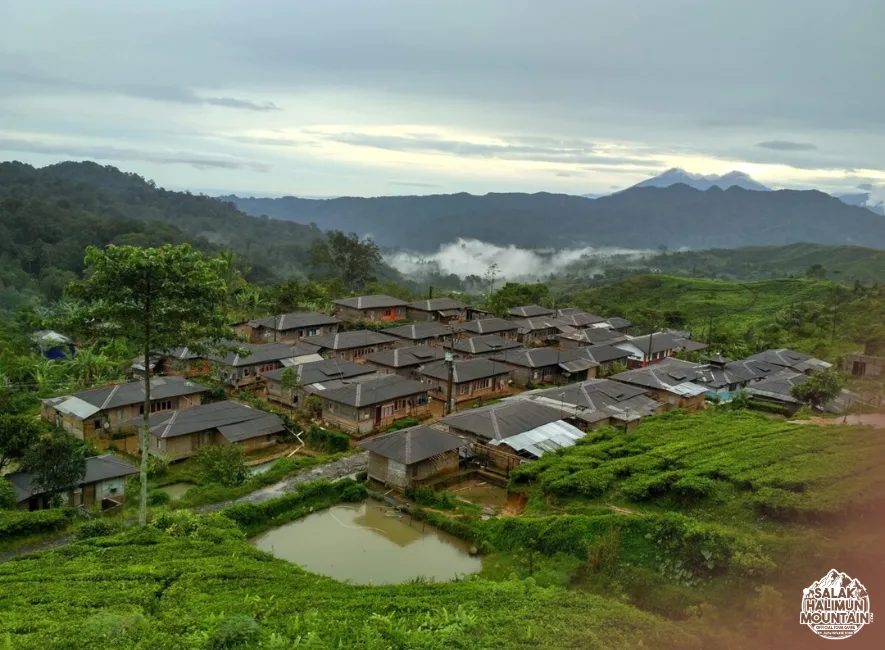
salakhalimunmountain.com – the road to Desa Wisata Malasari does not arrive with spectacle. It winds quietly through tea plantations, follows the curve of rivers born deep in the forest, and slowly narrows as the air grows cooler and heavier with moisture. Here, the rainforest does not announce itself. It simply exists, breathing around the village, shaping every sound, every routine, and every decision made by the people who call this place home.
Desa Wisata Malasari sits on the western edge of Halimun Salak National Park, not as a destination built for tourism, but as a living village whose survival has always been intertwined with the forest. To understand Malasari is to understand conservation not as policy, but as daily life.
What Desa Wisata Malasari Really Is
Desa Wisata Malasari is often described as a tourism village, but that label only touches the surface. At its core, Malasari is a rural community shaped by geography, tradition, and the boundaries of one of Java’s largest remaining rainforest ecosystems. Long before the word wisata appeared in its name, Malasari was already living with conservation as a necessity.
The village lies within the administrative boundaries of Bogor Regency, yet culturally and ecologically it belongs to the forest. Houses are built with an awareness of water flow and soil movement. Paths follow contours carved by decades of foot traffic rather than concrete planning. Gardens blend food crops with forest species, creating a soft transition between human space and wilderness.
Tourism here was never meant to replace village life. It was introduced as a way to protect it.
Malasari as a Buffer Village of Halimun Salak National Park
In conservation terms, Desa Wisata Malasari is known as a buffer village. This means it forms a protective human boundary between the core rainforest of Halimun Salak National Park and the outside world. The role is quiet but crucial.
Buffer villages reduce pressure on protected forests by creating livelihoods that do not depend on logging, hunting, or land clearing. In Malasari, this role is visible in the way land is used and respected. Forest boundaries are clearly understood by villagers, not just as lines on a map, but as shared agreements passed down through generations.
Residents know which areas are sacred water catchments, which slopes are too fragile to farm, and which forest paths are meant only for guided access. This knowledge does not come from textbooks. It comes from living close enough to the forest to understand its consequences.
Why Buffer Villages Matter
Without villages like Malasari, national parks would face constant pressure from expansion and exploitation. The forest would be seen as empty land rather than a living system. Buffer villages act as guardians, absorbing the impact of human presence while protecting the core ecosystem from harm.
In Halimun Salak, where biodiversity is among the richest in Java, this role is especially important.
Daily Life Shaped by Conservation Rules
Life in Desa Wisata Malasari moves at the pace of nature. Morning begins with mist rising from rice fields and rivers, and the sound of insects fading as daylight strengthens. Farmers walk narrow paths between paddies, careful not to disturb irrigation channels fed by forest springs.
Conservation rules are not experienced as restrictions here. They are understood as boundaries that allow life to continue. Villagers know when planting must stop to allow soil to recover. They understand why chemical use is limited near water sources. They respect seasonal changes that dictate when forest access is safe or forbidden.
Even construction follows unwritten ecological rules. Heavy materials are avoided on unstable slopes. Trees are not cut without communal discussion. Waterways are never blocked.
This way of life may appear simple, but it is the result of long adaptation and collective discipline.
Forest Protection Begins at the Village Edge
The forest around Malasari is not a distant backdrop. It begins just beyond the last house, where paths disappear into dense canopy and the air turns cooler and darker. Protecting this forest is not an abstract goal. It is directly linked to survival.
Illegal logging and wildlife disturbance threaten not only biodiversity, but water stability and soil integrity. Villagers understand that once trees are lost, rivers change course, floods increase, and harvests fail.
Community patrols, cooperation with park authorities, and local reporting systems help monitor forest activity. More importantly, social pressure discourages destructive behavior. Everyone knows that harming the forest harms the village.
Water Sources That Sustain the Lowlands
Halimun Salak National Park is a major water catchment area for West Java. Springs originating near Malasari feed rivers that flow far beyond the village, supplying agriculture and communities downstream.
Protecting these water sources is a responsibility the villagers take seriously. No farming is allowed near key springs. Forest cover is maintained to stabilize water flow. Waste management, though simple, is handled with care to prevent contamination.
When you drink from a clear mountain stream near Malasari, you are tasting the result of decades of restraint and respect.
Biodiversity Depends on Human Restraint
The forests surrounding Desa Wisata Malasari are home to countless plant and animal species, many of them sensitive to disturbance. Birds call from high canopy layers. Amphibians cling to moss-covered rocks along shaded streams. Insects fill the air with constant movement and sound.
This biodiversity survives not because humans are absent, but because they know when to step back. Hunting is limited and regulated by tradition. Certain forest areas are avoided entirely. Noise and large groups are discouraged.
Visitors often expect wildlife to reveal itself easily. In Malasari, nature is not on display. It is present, but only on its own terms.
Why Malasari Is More Than a Tourist Stop
Desa Wisata Malasari challenges the idea that tourism must always involve entertainment. Here, participation means listening, observing, and respecting rhythms that existed long before visitors arrived.
Homestays are family homes, not accommodations designed for spectacle. Meals reflect seasonal availability. Activities follow weather and forest conditions, not schedules.
Tourism income supports conservation by giving villagers alternatives to forest exploitation. But it is intentionally limited. Growth is measured, not maximized.
Malasari matters because it demonstrates a different model of interaction with protected landscapes. One where communities are partners in conservation, not obstacles to it.
A Living Example of Sustainable Balance
In a world where many natural destinations are consumed until they collapse, Desa Wisata Malasari stands quietly as proof that restraint can be powerful. The village protects the forest, and the forest protects the village.
This balance is fragile. It depends on continued respect from both residents and visitors. Those who come here are not just guests. They become temporary participants in a long-standing relationship between people and rainforest.
As you walk Malasari’s paths, hear the river moving beneath wooden bridges, and feel the damp forest air settle on your skin, you begin to understand that conservation is not an abstract concept. It is a way of living.
So, if you’re ready to explore the wonders of Mount Salak Halimun, head over to our ONLINE BOOKING PAGE and let’s start planning your adventure. Or simply CLICK THIS LINK to chat with us on WhatsApp.
With our team, you’re not just getting a guide; you’re gaining a local friend who will ensure your trip is nothing short of extraordinary.