salakhalimunmountain.com – If you find yourself wandering the quiet, mist-draped outskirts of the Mount Salak Halimun rainforest in the early morning, you might hear a rhythmic tapping sound echoing from the high canopy of the palm trees. This is the heartbeat of the village, a sound that has signaled the start of the day for generations of Sundanese mountain dwellers. While the world outside rushes toward modern sweeteners, the communities nestled in the shadows of Mount Salak remain dedicated to an ancient craft: the production of authentic palm sugar, known locally as Gula Aren. This deep-brown, caramel-scented treasure is more than just an ingredient; it is a labor of love that connects the wild energy of the rainforest with the humble hearths of the village homes. To taste a piece of warm, freshly molded palm sugar is to taste the very essence of the mountain itself, distilled through fire and traditional wisdom.
The Guardian of the Canopy: Tapping the Nira
The journey of palm sugar begins high above the ground. The Arenga pinnata, or sugar palm tree, thrives in the humid, volcanic soil of the Salak Halimun region. Unlike plantation crops, these trees often grow wild or in semi-managed forest gardens, acting as vital anchors for the mountain slopes. The local harvesters, known as “panyadap,” are the true acrobats of the forest. Without harnesses or modern climbing gear, they scale the tall, rough trunks using nothing but “lodong”—long bamboo tubes slung over their shoulders—and a lifetime of experience. They seek out the male flower stalks of the palm, which hide the precious “nira” or sweet sap within. It is a dangerous and delicate task that requires a deep respect for the tree and the spirits of the forest.
A Morning Ritual of Patience and Skill
A panyadap must visit his trees twice a day, every single day. In the cool air of dawn, he climbs to check the flow of the sap. Before the sap can be collected, the flower stalk must be “massaged” and beaten gently with a wooden mallet to stimulate the flow of liquid. This is a rhythmic, meditative process that ensures the tree remains healthy and productive. Once the stalk is ready, a thin slice is taken from the end, and the bamboo lodong is fastened to catch the slow, steady drip of the nira. This liquid is pale, translucent, and incredibly sweet, but it is also fragile. If left too long in the tropical heat, it begins to ferment into a sharp palm wine. The harvester must be quick and precise, bringing the fresh bounty down to the village before the sun climbs too high over the Salak peaks.
The Transformation in the Forest Kitchen
Once the nira reaches the village, the air begins to change. The sweet, grassy scent of the raw sap is replaced by a deep, smoky aroma that clings to the traditional wooden houses. In the “dapur” or traditional kitchen, the women of the village take over the process. A large iron wok, or “kawah,” is placed over a steady wood fire. The nira is filtered through palm fibers to remove any forest debris and then poured into the wok to begin its long transformation. This is not a process that can be rushed. For hours, the sap must be stirred constantly with a long wooden paddle to prevent it from burning as the water slowly evaporates and the sugars begin to caramelize.
The Alchemy of Wood and Fire
The choice of firewood is crucial to the final flavor of the Gula Aren. Local producers often use fallen branches from the surrounding rainforest, such as Rambutan or Albasia wood, which provide a consistent heat and contribute a subtle, smoky undertone to the sugar. As the liquid boils, it thickens from a thin juice into a golden syrup, and finally into a dense, bubbling dark amber mass. The stirrers must watch the bubbles closely; there is a specific moment, known only to the experienced eye, when the sugar reaches the perfect consistency. If taken off too early, it will not set; if left too long, it becomes bitter. It is a moment of culinary alchemy that has been passed down from mother to daughter for centuries.
Molding the Heart of the Mountain
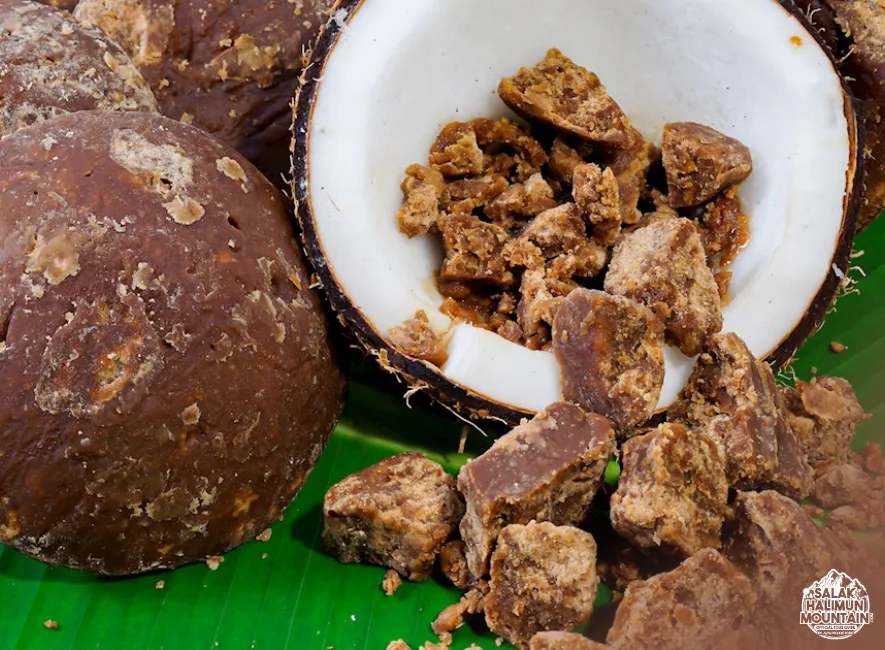
When the sugar is finally ready, the wok is lifted from the fire. The thickened mass is stirred vigorously as it cools, a process that aerates the sugar and gives it its characteristic fine texture. While still warm and pliable, it is poured into molds. In the villages around Mount Salak, these molds are often made from sliced bamboo rings or coconut shells, giving the final product its iconic circular or dome shape. Some artisans even use folded pandan leaves to create small, fragrant packets of sweetness. As the sugar cools and hardens, it captures the spirit of the day—the smoke of the fire, the sweetness of the palm, and the cool moisture of the mountain air.
The Many Faces of Gula Aren
While the solid blocks are the most traditional form, the villagers have adapted to modern tastes by producing “Gula Semut” or ant sugar—a granulated version that is easier to use in coffee and baking. This requires even more stirring and a precise drying process to ensure the granules remain free-flowing. Regardless of the final shape, the quality of Salak’s palm sugar remains unparalleled. It possesses a complex flavor profile that hints at butterscotch, toasted nuts, and a touch of saltiness from the volcanic earth. It is a natural sweetener that is far healthier than refined sugar, containing trace minerals and a lower glycemic index, making it a gift for both the palate and the body.
A Sustainable Bond with the National Park
The production of palm sugar is one of the most sustainable ways for local communities to earn a living while protecting the Halimun Salak National Park. Because the sugar palm tree requires a healthy forest environment to thrive, the villagers have a direct incentive to prevent illegal logging and forest fires. Every tree that is tapped is a tree that is guarded. This “non-timber forest product” allows families to thrive without cutting down the giant Rasamala or Jamuju trees that provide the canopy. When you visit these villages, you see a landscape where the forest and the community are one. The palm trees act as a buffer zone, protecting the core of the national park while providing a sweet bounty for those who live on its edge.
The Culinary Soul of West Java
In Sundanese culture, palm sugar is the golden thread that runs through almost every traditional dish. It is the base for the rich “sambal” that accompanies every meal, the secret to the deep color of “semur” stews, and the essential heart of snacks like “klepon” and “serabi.” Even the morning drink of the panyadap—a mixture of fresh nira and crushed ginger—is a testament to the versatility of this mountain treasure. In the villages near Mount Salak, offering a guest a piece of palm sugar with a glass of tea is a gesture of warmth and hospitality. It is a way of sharing the sweetness of their land and the pride of their heritage with those who come to visit.
Preserving a Fading Craft
Despite its importance, the craft of traditional palm sugar making faces challenges. It is hard, physical work that requires the youth to stay in the villages rather than seeking jobs in the distant cities of Bogor or Jakarta. By highlighting the beauty of this process, we hope to instill a sense of pride in the next generation of sugar makers. Supporting local palm sugar means supporting the preservation of the rainforest and the survival of a unique cultural identity. Every time a bamboo mold is filled, a piece of Indonesian history is saved. We invite you to see this process for yourself, to feel the heat of the kitchen fire and to smell the intoxicating aroma of the bubbling nira under the watchful gaze of the mountain.
A Sweet Journey Through the Foothills
Walking through a palm-sugar producing village is a journey into a slower, more intentional way of life. You will see the lodong bamboo tubes drying in the sun, the stacks of firewood ready for the next boil, and the smiling faces of the women as they unmold the day’s harvest. It is an experience that humbles you, showing just how much effort goes into a single block of sugar. We take you beyond the typical tourist paths, allowing you to sit by the fire and learn from the masters of this craft. You won’t just leave with a souvenir; you will leave with a deeper understanding of how the people of Mount Salak have turned the gifts of the forest into a sustainable and delicious way of life.
So, if you’re ready to explore the wonders of Mount Salak Halimun, head over to our ONLINE BOOKING PAGE and let’s start planning your adventure. Or simply CLICK THIS LINK to chat with us on WhatsApp.
With our team, you’re not just getting a guide; you’re gaining a local friend who will ensure your trip is nothing short of extraordinary.