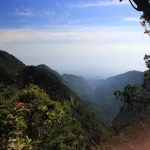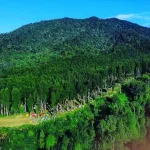
salakhalimunmountain.com – The deep forest of Mount Salak always carries a certain hush, a kind of ancient breath that rises from its volcanic heart. Every step on its mossy trail feels like stepping into a story that has been unfolding long before any visitor arrived. And among all the hidden wonders of this mystical mountain, Kawah Ratu stands as one of its most powerful, intriguing, and unforgettable destinations.
Recently, volcanic activity around Mount Salak has increased, triggering frequent tremors in the region. Because of this, trekking routes to Kawah Ratu have been temporarily closed for safety. While access awaits reopening, this moment feels like the right time to revisit and reflect on earlier journeys through this powerful landscape and share an immersive guide for those planning their future adventure.
In this article, we will walk through the volcanic history of Mount Salak, explore the trekking routes to Kawah Ratu, and break down the costs for visitors. So take a deep breath of that imaginary cool mountain air, and let’s begin.
The Volcanic History of Mount Salak
Many travelers are surprised to hear that Mount Salak is an active volcano. Classified as a type A stratovolcano, Salak has erupted several times in recorded history. Yet its crater does not sit on a dramatic summit cone like many other Indonesian volcanoes. Instead, Kawah Ratu lies quietly on the southern slopes — a reminder that volcanic activity does not always follow the familiar patterns we expect.
The Eruption Years
1699 — The first recorded eruption occurred on Monday, January 5, 1699, coinciding with a major earthquake near Batavia (modern-day Jakarta). The tremor impacted a wide region across West Java and southern Sumatra, and historical records link the seismic event with volcanic activity at Mount Salak.
1780 — The second known eruption took place at Kawah Ratu. With a VEI 2 rating, this eruption expelled an estimated 1–5 cubic kilometers of volcanic material.
1902–1903 — Another eruption struck Kawah Ratu, this time a phreatic event triggered by water interacting with rising magma. The explosion released clouds of ash into the forested slopes.
1919 — A similar phreatic eruption occurred again, also rated VEI 2, reminding nearby communities of the volcano’s unpredictable nature.
1935 — The eruption shifted to the Cikuluwung Putri crater complex. A plume of ash rose from the trees, marking another phreatic burst.
1938 — The most recent recorded eruption, occurring on Monday, January 31, came from the same Cikuluwung Putri area, again producing ash and steam through a phreatic event.
Even today, the mountain remains geologically alive. Sulfur fumes linger at the crater, hot steam vents whisper near the rocks, and the earth beneath occasionally trembles — a living reminder of the forces shaping the land.
The Natural Allure of Kawah Ratu
Situated at 1,338 meters above sea level, Kawah Ratu spans an area of around 2 hectares. Though formed centuries ago from volcanic explosions, today it stands as one of the most intriguing geological destinations within Halimun–Salak National Park.
The approach itself is a sensory experience: the smell of sulfur drifting through the canopy, the rumble of underground heat, and the soft hum of insects weaving through the thick, misty air. For hikers and outdoor lovers from Bogor, Sukabumi, and beyond, this place has long been a favorite escape.
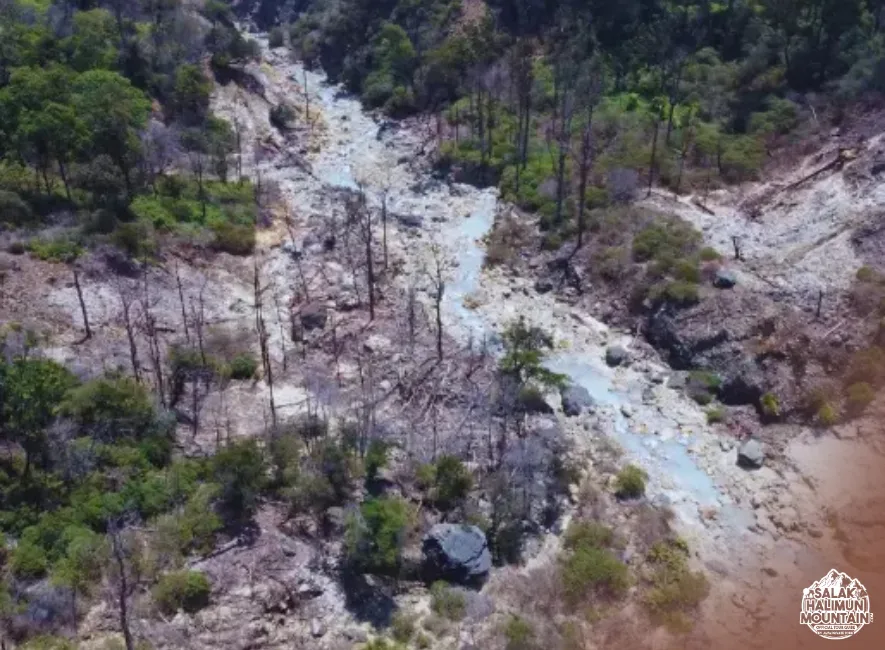
Its trails, gentle yet varied, are often used as warm-up routes before attempting higher peaks. The crater also features striking natural phenomena, including patches of mineral-stained rocks, bubbling mud vents, and a mesmerizing blue river that flows into Cikuluwung. For anyone passionate about geology, this is a rare opportunity to witness volcanic activity up close — safely, and without needing to scale a mountain summit.
Trekking Routes and Estimated Hiking Times
There are two main trekking approaches to Kawah Ratu: from Pasir Reungit in Bogor and from Cidahu in Sukabumi. Both trails are also used by hikers heading toward Puncak Salak 1.
| Route | Location | Trekking Duration |
|---|---|---|
| Kawah Ratu via Pasir Reungit | Gunung Bunder, Pamijahan, Bogor | ± 3 hours |
| Kawah Ratu via Javana Spa | Cidahu, Sukabumi | ± 2.5 hours |
1. Via Pasir Reungit, Bogor
The trek begins from the registration post at Gunung Bunder — a popular recreation zone filled with waterfalls, camping areas, and lush forest. The hike typically takes around 3 hours, following a natural path of stone, earth, mud, and small river crossings.
Along the way, hikers pass through three trail posts before reaching the crater area. Mossy roots twist across the ground, cicadas buzz in the canopy, and the deeper you go, the more the forest seems to close around you. Footwear with good grip is a must, as the terrain often becomes wet and slippery.
2. Via Javana Spa, Cidahu Sukabumi
For travelers coming from Sukabumi, the Cidahu route is the ideal choice. Sharing the same initial route as the trail to Salak 1, this path branches at Simpang Bajuri — where hikers turn left toward the crater, following clear signage through the open forest.
This trail features more open landscapes and fewer towering trees compared to the Bogor side, offering wider views of the rugged slopes. The journey takes about 2.5 hours, crossing streams, earth trails, and rocky segments shaped by the mountain’s past eruptions.
Entry Fees for Kawah Ratu
The ticket prices listed below reflect typical costs via the Pasir Reungit route. These may change depending on park regulations.
- Mount Halimun–Salak National Park entrance: Rp25.000 per person per motorcycle
- Kawah Ratu trekking ticket: Rp15.000 per person
- Motorcycle parking: Rp10.000 per vehicle
The ticket counter operates only until 11:00 AM. After this time, new hikers are not allowed to begin the trek for safety reasons.
Visitor requirements:
- Minimum 3 people per group if at least one has visited before
- Minimum 5 people if all are first-time visitors
- Groups below the minimum must hire a guide (approx. Rp150.000)
Important Safety Notes for Visitors
In the past, camping near Kawah Ratu was allowed. However, after the tragic 2007 Persami incident involving the loss of six students, camping has been prohibited. The area is considered too risky due to sudden surges of volcanic gases and the presence of wild animals such as wild boars.
Visitors are strongly advised to avoid trekking during heavy rainfall. Flooded streams, slippery paths, and increased volcanic gas activity pose significant hazards. When Mount Salak speaks — through tremors, steam, or sudden changes in air temperature — it is always best to listen.
Final Thoughts
Kawah Ratu remains one of the most fascinating destinations on Mount Salak — a place where raw volcanic power meets lush forest beauty. Whether you come for the geology, the adventure, or the serene rainforest atmosphere, the trail to the crater offers a journey that lingers long after you leave.
So, if you’re ready to explore the wonders of Mount Salak Halimun, head over to our ONLINE BOOKING PAGE and let’s start planning your adventure. Or simply CLICK THIS LINK to chat with us on WhatsApp.
With our team, you’re not just getting a guide; you’re gaining a local friend who will ensure your trip is nothing short of extraordinary.