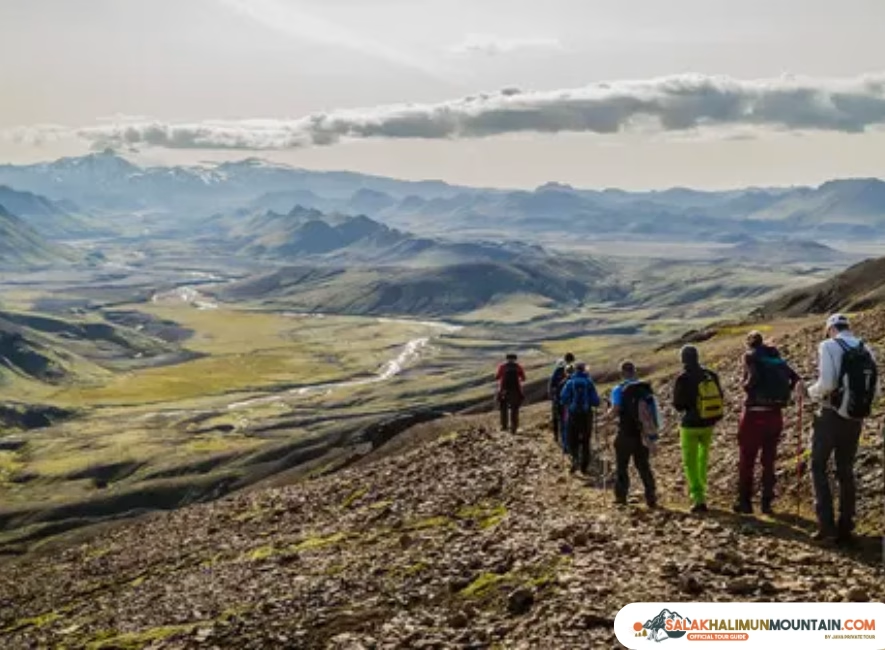
salakhalimunmountain.com – Descending the steep, high-gradient slopes of Mount Salak is widely considered by experienced trekkers to be more physically and mentally demanding than the climb up. Wet, exposed volcanic clay, mossy root ladders, unpredictable mud chutes, and loose rock fragments turn every downhill step into a dynamic balance puzzle. After hours of climbing, physical fatigue combined with dropped concentration leads to “descent-phase slips”—the primary cause of trail injuries on Java’s volcanic peaks. Mastering focus techniques for technical Salak descents is a vital backcountry discipline that protects your joints, maintains momentum, and keeps you safe on steep terrain.
Descending requires continuous cognitive processing as your brain evaluates traction, slope angles, and foot placement in real time. When physical tiredness sets in during late-afternoon descents, your cognitive processing speed naturally slows, leading to delayed reflexes and sloppy footwork. By applying focused visual scanning, maintaining active somatic postures, structuring rhythmic footwork, and leveraging short cognitive resets, you can navigate even the slickest descents of Mount Salak with complete control and confidence.
Active Visual Scanning and the “Three-Step Ahead” Rule
The foundation of technical descent focus is proactive visual management. A common mistake tired hikers make is staring exclusively at their boots, reacting to obstacles only as their feet hit the ground. This reactive stance causes abrupt stops, jerky movements, and frequent loss of balance.
Implement the “Three-Step Ahead” visual scanning technique. Continually alternate your gaze between two focal points: scan 3 to 5 meters ahead down the trail to map out your overall line and identify major hazards (such as slick mud patches, loose rock sections, or drop-offs), then flick your eyes back to the immediate 1 to 2 meters ahead to execute precise foot placement. Mapping your line seconds in advance allows your subconscious mind to prepare balance adjustments smoothly before your weight shifts.
Reading Terrain Traction Cues
Mount Salak’s volcanic soil changes texture constantly depending on moisture and canopy cover. Train your eyes to read subtle surface traction cues while scanning ahead.
Seek out high-friction surfaces such as exposed rough tree roots, embedded basalt rocks with coarse textures, and firm leaf litter beds. Avoid stepping directly on smooth, wet rounded roots or shiny, waterlogged clay, which act like ice under boot soles. If you must step on slick clay, place your foot flat to maximize tread surface contact rather than digging in with your heel.
Biomechanical Alignment for Dynamic Balance
Maintaining high mental focus is significantly easier when your physical body is positioned for optimal stability. Proper downhill posture reduces joint strain on knees and ankles while lowering your center of gravity.
Keep your knees slightly flexed at all times, acting as natural shock absorbers with every step. Lean your torso slightly forward over your hips rather than leaning backward away from the slope. While leaning back feels instinctively safer, it shifts your center of gravity behind your feet, causing your boots to slip out from under you on wet clay. Keeping your weight centered over your feet keeps your tread engaged with the ground.
Conserving Energy with Trekking Pole Placement
Trekking poles are indispensable tools for maintaining focus and balance during steep, technical descents.
Extend your trekking poles slightly longer than your standard flat-ground length so you do not have to hunch forward when reaching downhill. Plant both poles firmly ahead of your feet before stepping down into steep root steps or mud drops. Poles act as secondary stability anchors, absorbing up to 20% of the impact force on your knees and preventing sudden lateral slips.
Rhythmic Footwork and The “Light-Footed” Cadence
Heavy, stomping footsteps are a clear sign of waning focus and physical fatigue. Dropping your full body weight heavily onto downhill steps creates high impact forces that exhaust quadriceps and loosen traction.
Adopt a “light-footed,” quick-cadence stepping technique. Take shorter, faster micro-steps rather than long, lunging leaps down steep drops. Keeping your feet beneath your hips allows you to test traction rapidly; if a rock shifts or mud gives way, your weight is not fully committed, allowing you to recover your balance instantly without falling.
Executing the “Side-Step” on Severe Incline Clay
When descending severe vertical pitches where forward traction is non-existent due to fresh rainwater, switch from a forward-facing stride to a lateral side-step.
Turn your body perpendicular to the fall line, dig the side edge of your uphill boot into the slope, and lower your downhill foot softly to find the next stable root or ledge. Side-stepping lowers your center of mass, engages larger hip stabilizer muscles, and provides maximum edge control on wet volcanic inclines.
Structuring Mental Micro-Resets and Cognitive Pacing
Sustained concentration during a long 3-hour descent requires immense mental energy. Pushing continuously without cognitive breaks leads to dropped attention, where mind-wandering replaces active scanning.
Incorporate short “cognitive micro-resets” every 45 minutes of technical downhill travel. Step off the active trail to a safe, wide ledge, unbuckle your chest strap, and drink several gulps of water or an electrolyte mix. Close your eyes for 60 seconds to rest your optic nerves from intense visual tracking, take four deep abdominal breaths, and consume a fast-acting glucose snack like dried fruit or a gel. Refueling your brain restores processing speed and refreshes your focus for the next technical segment.
Focus techniques for technical Salak descents bridge the gap between physical endurance and mental precision. By scanning ahead, maintaining athletic biomechanics, taking light micro-steps, and scheduling mental resets, you turn intimidating volcanic descents into a smooth, controlled, and deeply satisfying mountain experience.
So, if you’re ready to explore the wonders of Mount Salak Halimun, head over to our ONLINE BOOKING PAGE and let’s start planning your adventure. Or simply CLICK THIS LINK to chat with us on WhatsApp.
With our team, you’re not just getting a guide; you’re gaining a local friend who will ensure your trip is nothing short of extraordinary.