salakhalimunmountain.com – Trekking through the sprawling rainforest wilderness of Mount Salak and Halimun National Park offers an encounter with one of Java’s most species-rich ecosystems. Beneath the thick, multi-tiered canopy, giant fig trees, mossy ridges, and dense bamboo groves form a labyrinth of green. As you push deeper into remote national park zones, the primary trekking route often crisscrosses with a complex web of wildlife corridors. To an untrained eye, a clear opening cutting through dense undergrowth looks like an inviting shortcut or a continuation of the hiking trail. However, confusing a wildlife path with a human route is one of the quickest ways to wander off-track. Learning the art of identifying animal trails vs human hiking paths is an essential navigation skill for every tropical trekker.
Tropical rainforests are crisscrossed by countless creatures—from Javan leopards, wild boars, and barked deer (muncak) to javan gibbons and civets. Over generations, these animals create distinct travel corridors between feeding grounds, salt licks, wallows, and water sources. While these paths can look surprisingly defined, they are engineered for non-human quadrupedal or arboreal locomotion. Following an animal trail usually leads you away from established ridge lines and plunges you into impassable ravines, thorny rattan thickets, or dead-end river gorges. By observing path geometry, clearance height, ground-level soil impressions, and vegetation wear, you can easily distinguish animal tracks from human hiking lines.
Path Geometry and Clearance Height
The most immediate distinction between a human hiking trail and an animal path lies in its vertical clearance and overall geometry. Human trail builders construct paths to accommodate an upright, bipedal frame carrying a backpack. Official hiking trails feature a vertical clearance tunnel of at least 1.8 to 2 meters (six to seven feet) above the ground, allowing trekkers to walk without constantly ducking under low branches or crawling through brush.
Animal trails, on the other hand, are shaped by four-legged mammals or ground birds whose centers of gravity sit much closer to the forest floor. A wild boar or muntjac deer corridor may look open near the ground, but its overhead clearance often stops abruptly at knee or waist height. If you find yourself repeatedly ducking under low-hanging branches, getting your backpack snagged on arching vines, or forced onto all fours to keep moving forward, you have almost certainly stepped off the human trail and onto an active wildlife path.
Analyzing Trail Gradient and Route Selection
Humans and forest animals choose lines through steep mountain terrain using entirely different logic. Human hiking trails are designed for efficiency and safety over long distances; they use gradual switchbacks, climb along stable ridge spines, and follow wide bench contours to avoid dangerous drop-offs and erosion.
Forest animals, particularly wild boars and deer, do not use switchbacks. They move with incredible power and agility directly up or down the fall line—the steepest direct slope between two points. Animal paths cut straight through vertical clay banks, dive down sheer ravine walls, or squeeze through tiny gaps between boulder clusters where a human with a heavy pack cannot safely maneuver. If a path suddenly drops straight down an exposed cliff face or charges directly into a thorn thicket without switchbacks, step back and re-verify your line.
Ground-Level Micro-Cues and Track Markings
When path geometry seems ambiguous, looking directly at the soil surface provides immediate, definitive proof of who made the trail. Footprints, soil compaction patterns, and ground disturbances leave distinct signatures that reveal the identity of recent trail users.
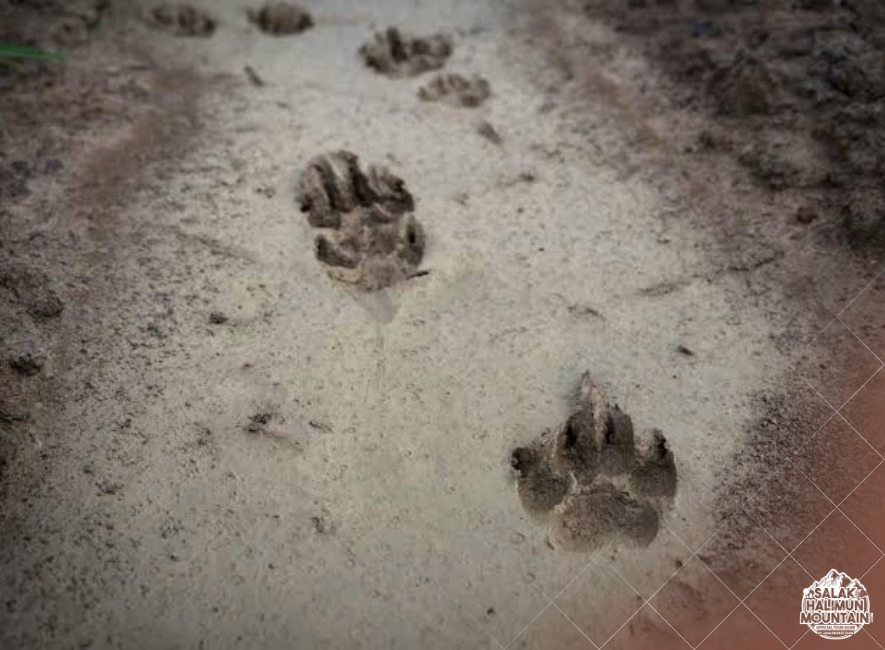
Human foot traffic leaves broad, linear boot prints characterized by geometric rubber tread patterns, distinct heel strikes, and wide, flat compression zones. Human boots also tend to crush leaves flat across a trail width of 30 to 60 centimeters. In contrast, ungulates like wild boars and muntjac deer leave sharp, cloven-hoof prints (two distinct tear-drop shaped impressions) that puncture deep into soft clay. Larger mammals like Javan leopards leave rounded, four-toed paw prints without claw marks, typically concentrated along narrow, single-file tracks no wider than 15 to 20 centimeters.
Identifying Wallows, Rubbing Posts, and Feeding Signs
Animal trails are directly connected to daily wildlife survival activities, leaving clear biological markers along their edges. Wild boar corridors frequently pass through mud wallows—shallow, muddy depressions filled with murky water where pigs roll to cool off and remove parasites. Surrounding wallows, you will often spot freshly churned earth where boars have used their snouts to root for tubers and earthworms.
Keep an eye out for rubbing posts—low tree trunks or exposed roots along the path where animals frequently rub their bodies. These trunks are often stripped of bark near ground level, coated in dried mud, and embedded with coarse animal hairs. You may also spot territorial scent marks, claw scratches on lower bark, or distinct animal droppings along the track. Finding these biological signs confirms that you are standing in a primary wildlife zone rather than on a public trekking route.
Vegetation Wear and Canopy Integrity
How surrounding plants and canopy layers are altered along a path offers another vital clue. A well-used human hiking trail causes widespread, uniform vegetation wear. Branches along both sides of the path are pushed back, small saplings are snapped at shoulder height by trekking poles or passing elbows, and low-lying roots are worn smooth and stripped of moss by thousands of boot strikes.
On an animal path, vegetation disturbance is highly concentrated near the ground. Low shrubs, ferns, and mosses may be heavily trampled, but overhead foliage remains completely untouched and dense. Look closely at the branches hanging directly over the path: if the upper canopy branches are pristine, covered in undisturbed moss, or interwoven with delicate spiderwebs at eye level, human bodies have not passed through that corridor recently.
Checking for Machete Cuts and Synthetic Markers
The presence of human tool marks is one of the most conclusive ways to verify an official trail. Forest rangers, local guides, and maintenance crews regularly clear overgrown sections of established trails using machetes (parang). Look closely at the stems, saplings, and hanging vines along the path edge.
A clean, smooth, angled cut on a woody stem or bamboo shoot indicates a sharp metal blade was used to clear the way. Animals do not leave clean cuts; they break branches jaggedly or strip leaves by chewing. Additionally, official human trails regularly feature artificial markers like colored surveyor tape tied to branches, wooden directional signs, or painted blazes on large trees—features you will never find along a wild animal corridor.
Navigational Protocols When Encountering Animal Trails
Recognizing an animal trail is only half the battle; knowing how to handle trail intersections where animal paths branch off from the main route is essential for maintaining seamless navigation in deep wilderness.
In dense rainforests like Halimun Salak, active animal trails frequently merge with human hiking paths for short distances, particularly near water crossings or narrow mountain saddles where terrain forces all creatures to use the same natural gap. When walking along a clear path, pay close attention to junctions where a smaller branch path veers off at a sharp angle. If the main, wide trail seems to fade while a narrower, steeper track dives into thick brush, pause immediately before taking the fork.
Executing the 10-Meter Stop-and-Scan Rule
Whenever you suspect you may have accidentally turned onto an animal trail, apply the 10-meter rule. The moment a path feels unusually narrow, steep, or overgrown, stop after taking no more than ten steps. Stand tall, take off your sunglasses if you are wearing them, and scan the surroundings at three distinct levels: ground, eye level, and overhead canopy.
Look back behind you to see if the main trail is visible. Look ahead for eye-level clearance, machete cuts, boot prints, or trail ribbons. If all three levels lack human indicators and the path ahead continues to shrink into a low, brush-filled tunnel, backtrack those ten steps immediately to the main junction. Never push forward through a low animal tunnel in the hope that it will widen out into a hiking trail.
Safety and Respect in Wildlife Corridors
Distinguishing animal paths from human trails is not only crucial for navigation—it is also vital for wilderness safety and wildlife conservation. Wandering onto an active animal corridor increases the chance of unexpected close encounters with large wildlife, such as wild boars protecting their young or solitary Javan leopards resting in remote thickets.
If you encounter an active wildlife path, treat it with respect. Avoid disturbing wallows, breaking surrounding vegetation, or leaving behind trash or food scraps that could disrupt natural animal behaviors. By staying strictly on designated human hiking routes, honing your tracking awareness, and reading the forest floor mindfully, you protect both your own safety and the wild, undisturbed integrity of Mount Salak and Halimun National Park.
So, if you’re ready to explore the wonders of Mount Salak Halimun, head over to our ONLINE BOOKING PAGE and let’s start planning your adventure. Or simply CLICK THIS LINK to chat with us on WhatsApp.
With our team, you’re not just getting a guide; you’re gaining a local friend who will ensure your trip is nothing short of extraordinary.