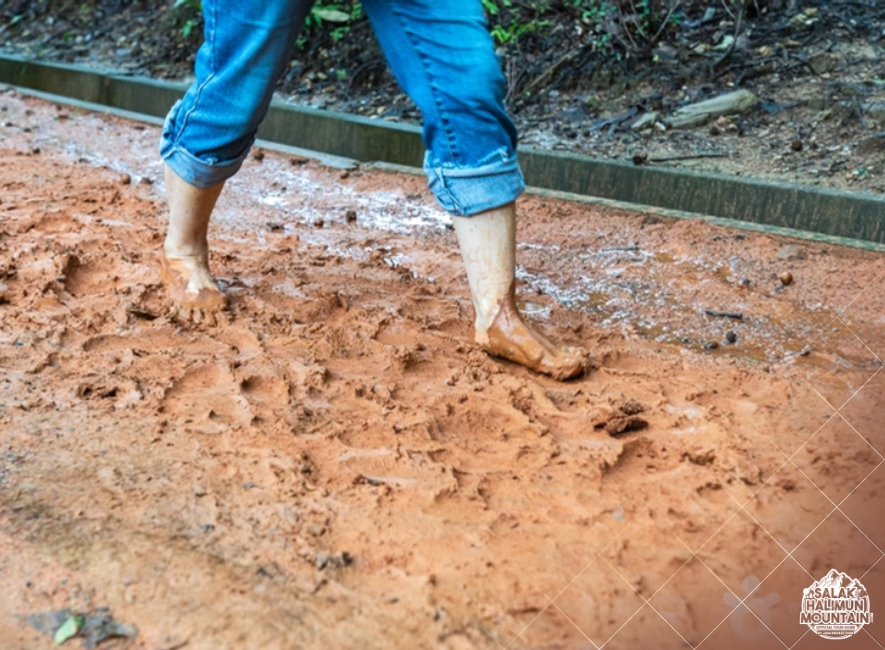
salakhalimunmountain.com – Trekking through the lush wilderness of Mount Salak and Halimun National Park means experiencing the raw beauty of a living tropical rainforest. But when an afternoon shower sweeps over the canopy, the familiar earth beneath your boots transforms almost instantly. The rich volcanic soil turns into slick, saturated clay paths that can feel as treacherous as walking on fresh ice. Descending a steep slope during a downpour is one of the most demanding challenges a hiker will face in West Java. Learning how to safely navigate slippery clay paths in the rain is an essential skill that transforms a potentially hazardous slide into a controlled, confident descent.
To an inexperienced trekker, a rain-soaked clay slope triggers an immediate sense of panic. The natural instinct is to lean away from the hill, tense up every muscle, and attempt to tread as lightly as possible on the toes. Unfortunately, this defensive posture almost guarantees a hard slip, sending you sliding down on your back or putting dangerous strain on your knees and ankles. Local mountain guides move down these same wet slopes with smooth, fluid control because they understand how clay behaves when wet. By adapting your body mechanics, choosing smart line choices, and trusting proper foot placement, you can descent safely and keep your journey through the rainforest enjoyable.
The Science of Wet Volcanic Clay Underfoot
To master slick downhills, it helps to understand why West Javanese clay becomes so unusually slippery during heavy rain. The volcanic soil around Mount Salak contains fine mineral particles, including bentonite and weathered ash, which absorb water rapidly. As rainwater saturates the topsoil, these microscopic particles expand and form a slick, micro-thin lubricating layer over the hard-packed trail beneath.
When your boot tread hits wet clay, the weight of your step compresses the trapped surface water into the tread pattern of your soles. If your tread is shallow or packed with sticky mud, the rubber loses all direct friction with the ground, creating a aquaplaning effect underfoot. Knowing that the surface layer is dynamic and constantly shifting allows you to adjust your footing to cut through the slick top layer to find firm purchase below.
Identifying High-Traction Surface Zones
When looking down a rain-drenched clay path, do not view the slope as a uniform slide. Train your eyes to read the subtle variations in surface texture. The center of a well-trodden single-track path is usually the slickest section because thousands of footsteps have compacted the clay into a smooth, impervious channel where water collects and flows like a stream.
Instead of walking down the center slick, look toward the edges of the trail. Look for patches where organic leaf litter, decaying wood fibers, or exposed fine tree roots interlock with the soil. These natural textures disrupt the smooth film of water, giving your boot tread something solid to bite into. Additionally, stepping into small side depressions or uncompacted earth along the trail margin often provides vastly superior grip compared to the polished center track.
Body Mechanics: Emphasize Heel Strikes and Centered Weight
The single biggest key to staying upright on a wet clay descent is maintaining correct body geometry. When the trail drops steeply and becomes slick, fear naturally makes hikers lean backward toward the safety of the uphill slope. However, leaning back moves your center of gravity far behind your feet. This removes all downward pressure from your soles and causes your boots to shoot out from under you instantly.
To maintain maximum friction, keep your weight centered directly over your landing foot, keeping your torso upright and perpendicular to the horizon rather than the slope. Keep your knees flexed, loose, and spring-like to lower your center of gravity. A lower, relaxed center of mass allows your body to absorb micro-slips instantly without losing overall balance or tipping over sideways.
Executing the Controlled Heel-Brake Step
On wet clay, landing on your toes or forefoot is a recipe for sliding forward. Your forefoot offers a smaller surface area and acts as a pivot point that easily skids along wet clay. Instead, execute a deliberate heel-brake step with every downward stride.
Lead with your heel, driving the back edge of your boot sole firmly down into the clay surface before rolling onto the flat sole. The stiff rubber heel acts like a spade, cutting through the slick surface layer of wet mud and anchoring into the firmer soil beneath. Once your heel bites, keep your weight planted flat-footed before making your next move. Short, controlled micro-steps with flat-footed weight distribution give you total control over your momentum.
Line Choice and Strategic Foot Placement
Descending safely in the rain is as much about mental route-finding as it is about physical footwork. Taking a extra second to plan your next three or four steps down the slope prevents you from getting trapped on an exposed, frictionless mud slide where stopping becomes impossible.
Look for natural step shelves carved into the hillside by tree roots or embedded rocks. Embedded basalt rocks can offer great footrests, but exercise caution: smooth, wet river stones or exposed rock faces can be just as slick as clay when coated in rain and mud. Always test a wet rock with a light touch before committing your full body weight to it, preferring coarse, textured rock surfaces over smooth ones.
Using Roots as Mechanical Stops
Tree root systems are a trekker’s best friend during a rainforest downpour. Thick roots growing horizontally across the path form natural, permanent retaining walls that trap soil and create flat, horizontal terraces. When stepping onto a wet root, never plant your foot on the rounded top apex, as wet wood bark can be extremely slippery.
Instead, wedge the toe or side of your boot firmly into the pocket directly behind or above the root structure. Using the root as a physical mechanical stop prevents your boot from sliding downhill regardless of how slick the clay around it might be. Always choose anchored, growing roots over loose, unattached branches lying on top of the mud.
Gear Adjustments for Torrential Rainforest Trails
Equipping yourself with the right gear—and using it correctly—makes navigating rain-soaked trails far safer and less stressful. Proper equipment acts as an essential extension of your body mechanics when conditions turn wet and wild on Mount Salak.
Choose footwear with aggressive outsoles featuring deep, widely spaced lugs designed specifically for mud. Wide gaps between lugs allow sticky clay to shed naturally as your boot flexes while walking, preventing mud from clogging your tread into a smooth, slippery surface. Mid-to-high cut boots also offer vital lateral ankle support if your foot undergoes a sudden unexpected twist in deep mud.
Maximizing Stability with Trekking Poles
Trekking poles are an absolute necessity for descending steep, slippery clay trails in the rain. They convert your two-legged gait into a rock-solid four-point balance system, drastically reducing the load on your knees and providing instant recovery anchors if a foot begins to slide.
Adjust your poles slightly longer for downhill sections so you do not have to lean forward to plant them. On steep, wet clay descents, plant both poles securely ahead of your body and slightly wider than your shoulders before taking a step. Press down firmly through your arms into the pole grips, ensuring both tips are anchored in firm dirt or behind root structures before stepping downhill with your lead foot.
Mental Composure and Leave No Trace Etiquette
When descending a mountain in heavy rain, maintaining mental composure is vital. Rushing down the trail out of a desire to reach dry shelter quickly leads to sloppy footwork, poor line selection, and avoidable falls. Accept that walking in the rain is part of the tropical adventure, slow down your pace, and celebrate every deliberate, secure step you take down the mountain.
Staying calm also helps protect the fragile mountain environment. When trails become muddy, hikers often make the mistake of stepping off the path onto pristine forest vegetation to avoid the slick clay. This practice widens the trail unnecessarily, destroys delicate understory plant life, and causes severe soil erosion during heavy rains. Stay on the designated path, embrace the mud, and move mindfully through the storm.
By understanding soil mechanics, maintaining a centered posture, executing sharp heel strikes, and using your poles as anchor points, you can master even the slickest downpours on Mount Salak and Halimun. Navigating a wet mountain slope with confidence is a true mark of a skilled tropical trekker, allowing you to enjoy the raw, atmospheric beauty of West Java’s high rainforests in any weather.
So, if you’re ready to explore the wonders of Mount Salak Halimun, head over to our ONLINE BOOKING PAGE and let’s start planning your adventure. Or simply CLICK THIS LINK to chat with us on WhatsApp.
With our team, you’re not just getting a guide; you’re gaining a local friend who will ensure your trip is nothing short of extraordinary.