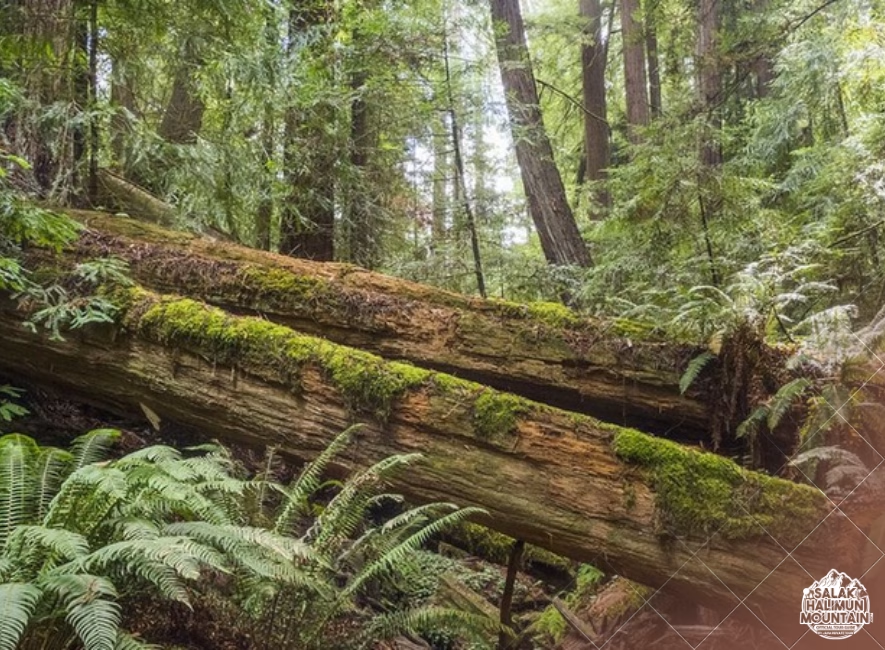
salakhalimunmountain.com – Walking through the lush, dense jungle of Mount Salak is a journey through a world where life grows in layers. Massive rainforest trees reach up into the clouds while orchids, giant mosses, and climbing vines cover every available inch of bark. Down on the forest floor, where the air is cool and heavy with moisture, you will often find fallen trees blocking the path. In a tropical rainforest, a fallen tree does not stay solid wood for long. High humidity, constant rainfall, and millions of tiny fungi turn fallen timber into soft, hollow shells. Learning the skill of identifying rotten logs before stepping on them is one of the most important habits you can build while trekking through Halimun Salak National Park.
To an untrained eye, a massive log across a narrow trail looks like a convenient bridge over a muddy ditch or a natural stepping stone to gain elevation. But stepping onto a decaying trunk can be surprisingly dangerous. A log that looks sturdy on the outside may be completely hollow inside, ready to collapse under your weight. When a rotten log gives way, your foot can plunge straight through the crumbling wood, leading to scraped shins, twisted knees, or a painful ankle injury mid-trek. By learning how to read the signs of decay, you can move through the jungle smoothly and avoid trail hazards.
The Anatomy of Tropical Forest Decay
To understand why fallen logs behave so unpredictably on Mount Salak, it helps to know how fast the rainforest recycles dead wood. Unlike temperate forests where fallen trees can stay firm for years, the warm, wet environment of West Java speeds up decomposition dramatically. Bacteria, bracket fungi, termites, and wood-boring beetles go to work on a fallen trunk almost immediately.
Decomposition on tropical mountain trails usually starts from the inside out or from the damp underside resting against the wet earth. Rainwater collects in small cracks in the bark, creating perfect conditions for fungal networks to eat away at the heartwood. A log can maintain its outer shape and bark texture while the structural wood inside turns into soft, sponge-like fibers. Knowing that outer appearances can be deceiving is the first rule of tropical trail safety.
Spotting Visual Indicators of Advanced Rot
Before you place your foot on any fallen log, take a quick second to inspect its surface. Your eyes can catch several clear visual warnings of decay long before your boot touches the wood. The most obvious indicator is the presence of shelf mushrooms, bracket fungi, or large clusters of colorful fungi sprouting along the sides or top of the trunk. Fungi feed directly on decaying wood fibers, meaning any log growing mushrooms is already structurally compromised.
Another sign to look out for is dark, peeling bark or sections where the bark has fallen away completely to reveal soft, fibrous wood beneath. If you see tiny piles of sawdust around the base of the trunk, wood-boring insects are actively hollowed out the interior. Additionally, logs that are thickly coated in dark, wet moss or growing ferns out of their upper surface have been sitting on the damp forest floor for a very long time and should be approached with caution.
Physical Testing: How to Check Wood Integrity
Visual checks are essential, but sometimes a log looks deceptively solid under a layer of fresh leaves. Developing a simple habit of physically testing fallen timber before placing your body weight on it will save you from unexpected falls. Local rainforest guides use quick, non-destructive checks to test logs in a fraction of a second without breaking their walking rhythm.
The easiest test is the trekking pole probe. If you carry trekking poles, take the tip of your pole and tap firmly on the top and sides of the log. If the tip sinks easily into the wood, or if the log produces a dull, hollow thud rather than a sharp, solid sound, the interior is rotten. Never step on a log that yields easily to a lightweight pole tip.
The Light Pressure Test
If you do not have trekking poles, use the sole of your boot for a controlled pressure test. Do not jump or step squarely onto the center of the log with your full body weight right away. Instead, keep your weight planted on your rear foot on solid ground, and rest your lead boot lightly on the log.
Apply gradual downward pressure while watching and feeling how the trunk responds. If you feel the wood flex, compress, or shift slightly under light pressure, take your foot back immediately. A solid trunk will feel completely rigid and unyielding. If there is any bounce or squishiness, treat the log as a hazard and find an alternative route around it.
Smart Foot Mechanics Around Fallen Timber
Even when a fallen log appears solid after a quick check, how you physically interact with it makes a huge difference in staying safe. On wet rainforest trails like those on Mount Salak, smooth bark and decaying wood can be as slick as ice, especially after an afternoon rain shower.
A fundamental rule of rainforest footwork is to step over logs rather than stepping directly on top of them whenever possible. Reaching your leg over a fallen trunk to plant your boot firmly in flat dirt on the opposite side eliminates the risk of slipping off rounded bark or breaking through rotten wood. If a log is too tall to step over comfortably, look for a safe path around the root base or branches instead.
Safe Foot Placement When You Must Step On Wood
There are times when a fallen tree is simply too large to step over or bypass, forcing you to use it as a stepping point. When stepping onto a large trunk is unavoidable, never place your foot on the high, rounded center of the log. Smooth, rounded bark offers minimal surface contact for your boot sole, making it very easy for your foot to slide off sideways.
Instead, look for natural notches, branch junctions, or flat spots where the wood is supported directly by the ground beneath it. Step flat-footed to maximize rubber contact with the surface. Keep your knees flexed, your center of gravity low, and move smoothly without jumping. Never leap off a log onto uninspected ground below, as hidden mud holes or sharp roots may be waiting under fallen leaf litter.
Gear and Awareness for Tropical Trail Hazards
Having appropriate gear provides a reliable safety net when navigating trail obstacles in Halimun Salak National Park. Proper footwear designed for tropical rainforest conditions gives you the traction and protection needed when dealing with wet, decaying vegetation underfoot.
Choose high-cut or mid-cut trekking boots with deep, aggressive rubber lugs. A stiff boot sole distributes your weight across a broader area, reducing the chance of sharp wood fragments puncturing your footwear if a rotten log collapses. Durable leather or reinforced synthetic uppers also protect your ankles and shins from sharp bark and hidden branches if your leg happens to slip between fallen trunks.
Maintaining Focus in Dense Jungle
Fatigue is often when missteps happen on the trail. After hours of climbing steep ridges in high humidity, it is easy to let your guard down and step blindly over obstacles. Staying mindful of your footing and keeping your eyes active on the path ahead is your best defense against avoidable injuries.
If you feel tired, take a moment to stop in a safe, flat area of the path. Rest, drink water, and enjoy the sights and sounds of the jungle around you. Watching silvery gibbons swing through the high canopy or listening to the calls of rainforest birds is best done with both feet planted on solid earth. When moving, give your full attention to the trail so you can enjoy every step of your rainforest adventure safely.
Preserving the Living Cycle of the Rainforest
Understanding rotten logs also deepens your appreciation for how the rainforest functions as an interconnected ecosystem. Dead and decaying wood is not just a trail obstacle; it is a vital part of the forest cycle. Fallen trunks act as nurse logs, providing rich nutrients and moisture for young tree seedlings, ferns, and wild orchids to sprout and grow.
Decaying timber also creates homes for countess species of insects, amphibians, and small forest creatures that keep the ecosystem balanced. By treading carefully, avoiding unnecessary destruction of decaying wood, and staying on established single-track paths, you protect your own safety while respecting the delicate natural processes that keep West Java’s ancient wilderness thriving for generations to come.
So, if you’re ready to explore the wonders of Mount Salak Halimun, head over to our ONLINE BOOKING PAGE and let’s start planning your adventure. Or simply CLICK THIS LINK to chat with us on WhatsApp.
With our team, you’re not just getting a guide; you’re gaining a local friend who will ensure your trip is nothing short of extraordinary.