salakhalimunmountain.com – To enter the high ridges of the Halimun sector is to step back into a prehistoric era that time seems to have forgotten. The landscape of giant ferns and ancient trees of Halimun Mountain creates a living gallery of botanical history, where the air is thick with the scent of damp earth and the heavy rainforest air clings to your skin like a velvet blanket. Unlike the more frequented slopes of its neighbor Salak, Mount Halimun offers a deeper sense of isolation and a vastness that humbles even the most experienced trekker. Here, the canopy is so dense that the sun must fight for every inch of ground, resulting in a world of emerald shadows and towering giants that have stood as silent witnesses to the changing of centuries. As your guide, I want to lead you through these misty corridors where the moss covered rocks are as old as the volcano itself and every step on the soft mud trails reveals a piece of Java’s primordial soul.
The Living Fossils: Giant Tree Ferns
Among the most iconic sights when exploring the giant ferns and ancient trees of Halimun Mountain is the Cyathea contaminans, more commonly known as the giant tree fern. These plants are true living fossils, having remained largely unchanged since the age of the dinosaurs. Standing up to ten meters tall, their slender trunks are topped with a magnificent crown of lacy, expansive fronds that filter the dense canopy light into a soft, ethereal glow. Walking beneath these giants feels like navigating a subterranean world where the ferns act as natural umbrellas, shielding the forest floor from the frequent highland downpours. Their presence is a sign of a healthy, moisture rich ecosystem that has never known the bite of a chainsaw.
The beauty of these ferns lies in their intricate detail. If you pause on the trail and look closely at a new frond, you will see it coiled into a tight “fiddlehead,” covered in soft, golden hairs that protect the delicate growing tip. As they unfurl, they reach toward the light with a graceful persistence that defines the character of the Halimun forest. In the giant ferns and ancient trees of Halimun Mountain hierarchy, these ferns occupy the middle story, creating a lush, textured layer between the damp ground and the high ceiling of the canopy. They are the guardians of the undergrowth, providing shade and shelter for the countless insects and small reptiles that call the Halimun slopes home.
The Sovereign Rasamala: Sentinels of the Highlands
No discussion of the giant ferns and ancient trees of Halimun Mountain would be complete without the Altingia excelsa, or the Rasamala tree. These are the undisputed kings of the West Javanese rainforest. Growing to heights of over 60 meters with perfectly straight, towering trunks, they provide the structural backbone of the entire national park. Their bark is often draped in thick blankets of moss and climbing vines, while their high branches host entire ecosystems of orchids and birds. When you stand at the base of a Rasamala and look up, your neck begins to ache before you ever see the first branch. These trees are not just plants; they are the anchors of the clouds, often invisible as their crowns disappear into the perpetual mountain mist.
The Rasamala is also famous for its fragrant resin, which has been used by local Sundanese communities for centuries. When a branch falls during a mountain storm, the heavy rainforest air is filled with a sweet, balsamic scent that tells you a giant has conceded to the elements. These fallen giants eventually become “nurse logs,” providing a nutrient rich foundation for the next generation of giant ferns and ancient trees of Halimun Mountain. The cycle of life here is slow and measured, dictated by the rhythm of the seasons and the patience of the wood. To touch the cold, mossy bark of a mature Rasamala is to connect with a lineage of life that predates our modern world by hundreds of years.
The Liana Network and Strangler Figs
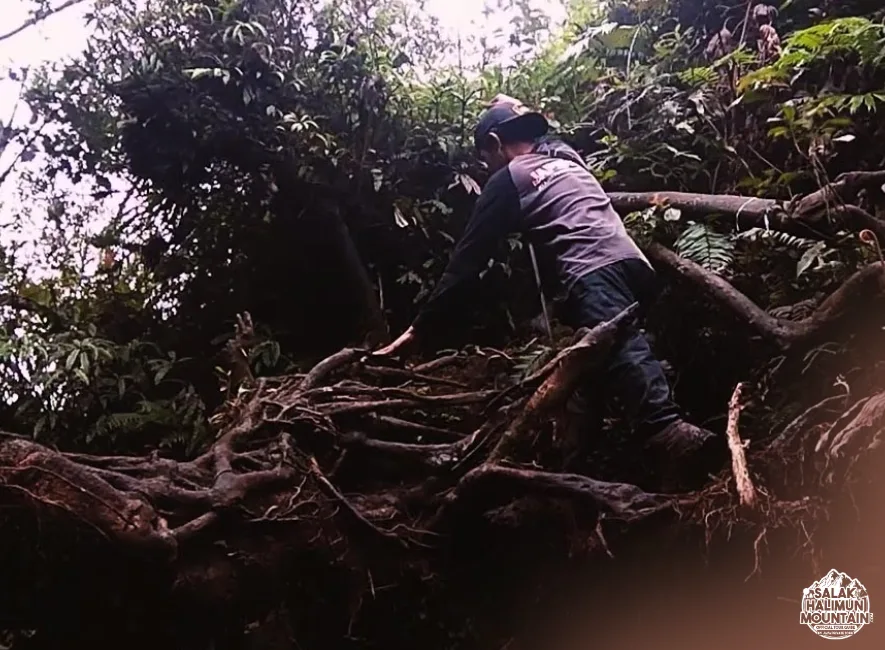
While the giant ferns and ancient trees of Halimun Mountain provide the vertical structure, the forest is stitched together by a complex network of lianas and the dramatic presence of the strangler fig. Lianas are woody vines that start on the forest floor and climb their way to the very top of the canopy in search of light. Some are as thick as a human thigh, twisting around the trunks of ancient trees like massive, wooden serpents. They act as “jungle highways” for primates like the Silvery Gibbon and the Grizzled Langur, allowing them to move across the forest without ever touching the ground. This interconnectedness is what makes the Halimun forest so resilient; the trees support the vines, and the vines, in turn, help stabilize the trees against high winds.
Then there is the Ficus, or the strangler fig, which tells a more competitive story of survival. A fig seed, dropped by a bird high in the branches of a Rasamala, begins to grow downward, sending aerial roots toward the soil. Over decades, these roots wrap around the host tree, slowly encasing it in a woody lattice. Eventually, the host tree may die and rot away, leaving a hollow, sculptural tower of fig roots that stands on its own. These hollow trees become vital habitats for owls and bats. In the world of giant ferns and ancient trees of Halimun Mountain, even death is a creative force, building new homes for the creatures of the night and ensuring that no space in the rainforest goes to waste.
The Mossy World of the Cloud Forest
As you climb higher toward the summit of Mount Halimun, the character of the giant ferns and ancient trees of Halimun Mountain shifts. You enter the “cloud forest,” where the moisture is so constant that every horizontal surface is covered in a thick, emerald carpet of bryophytes. Here, the trees become shorter and more gnarled, their branches twisting into fantastic shapes to withstand the wind and the weight of the water. The giant ferns of the lower slopes are replaced by smaller, more delicate species that cling to the rocks and trunks. This is a quiet, muffled world where the sound of your own breathing is the loudest thing you hear, occasionally broken by the distant call of a mountain bird.
This mossy realm acts like a giant sponge, capturing moisture from the clouds and slowly releasing it into the headwaters of the rivers that feed the valleys below. Protecting the giant ferns and ancient trees of Halimun Mountain is therefore a matter of regional survival. Without this high altitude “water tower,” the agricultural lands of West Java would face devastating droughts. Every mossy branch and every ancient trunk plays a role in the water cycle. When we trek through these high forests, we do so with a light touch, aware that we are walking through the very lungs and kidneys of the island. The beauty of the cloud forest is not just aesthetic; it is a functional masterpiece of natural engineering.
The Biodiversity of the Understory
Beneath the shadow of the giant ferns and ancient trees of Halimun Mountain lies a diverse world of understory plants that thrive in low light. Giant gingers with vibrant red blooms, wild begonias with spotted leaves, and carnivorous pitcher plants all find their niche in the nutrient rich soil. The heavy rainforest air keeps these delicate plants from drying out, while the decaying leaves of the ancient trees provide a constant source of compost. This layer of the forest is where you often find the smaller wildlife, from colorful forest crabs near the streams to the intricate webs of giant wood spiders. It is a world of detail that rewards those who are willing to crouch down and look closely.
The ferns also continue to diversify in this lower layer. You will see “walking ferns” that sprout new plantlets where their tips touch the ground, and “bird’s nest ferns” that create large baskets in the crooks of tree branches to catch falling debris. Every plant in the giant ferns and ancient trees of Halimun Mountain ecosystem has a strategy for survival. Some use color to attract pollinators, while others use thorns to deter herbivores. Exploring this variety is like reading a book written in a thousand different shades of green. For the nature lover, the understory is a treasure trove of botanical oddities that demonstrate the endless creativity of evolution in a stable, ancient environment.
Ethical Trekking Among the Giants
Visiting the giant ferns and ancient trees of Halimun Mountain is a privilege that comes with the responsibility of ecological respect. The ecosystems here are incredibly sensitive to human impact. The soft mud trails can easily erode if trekkers deviate from the path, and the delicate mosses can take years to recover from being stepped on. We always practice “minimal impact” trekking, ensuring that we leave no trace of our presence. We do not pick the flowers, we do not disturb the root systems, and we carry out everything we carry in. Our goal is to ensure that the ancient trees continue to grow undisturbed and that the giant ferns remain a sanctuary for the creatures of the mist.
We also encourage our guests to engage with the local culture of the Kasepuhan people who live on the fringes of the park. Their traditional wisdom regarding the forest is profound, and they have acted as the primary guardians of the giant ferns and ancient trees of Halimun Mountain for generations. By learning from them, we gain a deeper understanding of the forest’s value beyond its beauty. They see the trees as ancestors and the ferns as medicine, a perspective that fosters a deep, spiritual connection to the land. When you trek with us, you are partaking in this tradition of stewardship, ensuring that the “hidden mountain” remains hidden and healthy for the future.
Gear and Preparation for the Halimun Wilderness
To truly appreciate the giant ferns and ancient trees of Halimun Mountain, you must be prepared for the environment. The Halimun sector is significantly wetter and cooler than the surrounding lowlands. A high-quality waterproof jacket and sturdy hiking boots with good grip are essential for navigating the moss covered rocks and slippery slopes. We also recommend bringing a dry bag for your camera gear, as the mountain mist can be quite pervasive. Because the canopy is so thick, light levels can be low even at midday, so a tripod is helpful if you want to capture the sharp details of the ancient bark and the delicate fern fronds.
Beyond the physical gear, bring a sense of wonder and a patient spirit. The giant ferns and ancient trees of Halimun Mountain don’t reveal their secrets to those in a rush. To see the forest, you must become part of its rhythm. Sit silently for a moment and listen to the drip of water from a fern leaf or the creak of a massive Rasamala swaying in the wind. This is the true experience of Halimun—a slow, deep immersion into a world that exists on its own terms. With the right preparation and a respectful attitude, your journey through these ancient woods will be one of the most rewarding experiences of your life, a memory of a time when the world was still wild and green.
Conclusion: The Timeless Majesty of Halimun
As we emerge from the shadows of the giant ferns and ancient trees of Halimun Mountain, we carry with us the silence and the strength of the forest. These botanical giants are the true elders of Java, standing as reminders of the island’s natural glory. They teach us about resilience, about the power of slow growth, and about the beauty of an interconnected world. Whether you are seeking a physical challenge or a spiritual retreat, the ancient woods of Halimun offer a sanctuary like no other. We invite you to come and walk among the giants, to breathe the heavy rainforest air, and to witness the timeless magic of the “Hidden Mountain” for yourself. The ancients are waiting.
So, if you’re ready to explore the wonders of Mount Salak Halimun, head over to our ONLINE BOOKING PAGE and let’s start planning your adventure. Or simply CLICK THIS LINK to chat with us on WhatsApp.
With our team, you’re not just getting a guide; you’re gaining a local friend who will ensure your trip is nothing short of extraordinary.a.link/wvlvsa #SalakHalimun, #AncientTrees, #GiantFerns, #JungleTrek, #NaturePhotography, #ExploreJava, #BotanicalAdventures, #HiddenMountain {link}