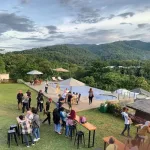
salakhalimunmountain.com – When you look across the landscape of West Java, one pattern quickly becomes clear. Mountains rise across the horizon in nearly every direction. Some are wrapped in rainforest, others are marked by steaming craters or wide volcanic lakes. These peaks are not randomly scattered across the island. They are part of a powerful geological system known as the volcanic belt of West Java.
This chain of volcanoes stretches across the province and forms part of a much larger structure that shapes the entire Indonesian archipelago. Mount Salak, standing beside the forests of Halimun Salak National Park, is one piece of this dynamic belt. To truly appreciate the mountain and its surrounding ecosystems, it helps to understand the deeper geological story connecting these volcanoes.
The Ring of Fire Connection
The volcanic belt of West Java exists because Indonesia sits along one of the most active geological regions on Earth, the Pacific Ring of Fire. This vast zone circles the Pacific Ocean and contains hundreds of volcanoes formed through tectonic plate movement.
In the case of Java, the Indo Australian tectonic plate moves slowly beneath the Eurasian plate. This process is called subduction. As the heavier oceanic plate sinks downward into the Earth’s mantle, intense heat and pressure cause parts of it to melt.
The resulting molten rock rises toward the surface, forming magma chambers beneath the crust. When pressure builds sufficiently, this magma erupts through volcanic vents, creating mountains over long periods of time.
West Java lies directly above one of these subduction zones, which explains why so many volcanoes appear across the region.
A Chain of Stratovolcanoes
The volcanic belt of West Java is primarily composed of stratovolcanoes. These mountains are built through repeated eruptions of lava, ash, and volcanic debris. Over thousands of years, these materials accumulate in layers, gradually forming tall and complex volcanic structures.
Stratovolcanoes tend to produce steep slopes, dramatic ridgelines, and multiple craters. Many of them also remain geologically active, even if they appear quiet on the surface.
Famous examples within West Java include Mount Salak, Mount Gede, Mount Pangrango, Mount Tangkuban Perahu, and Mount Papandayan. Each of these volcanoes contributes to the broader volcanic belt that defines the province.
Although they may appear separate when viewed individually, they are all connected by the same tectonic processes beneath the Earth’s crust.
How the Belt Shapes the Landscape
The volcanic belt does far more than create mountains. It shapes nearly every aspect of West Java’s environment. Volcanic eruptions deposit mineral rich material across the land. Over time, this volcanic ash breaks down into fertile soil.
This fertile ground supports the region’s lush forests, rice fields, tea plantations, and agricultural communities. Without the volcanic belt, West Java would not possess the same extraordinary biodiversity or agricultural productivity.
The mountains also influence weather patterns. Moist air from the surrounding seas rises along volcanic slopes, cooling and condensing into clouds. This process produces frequent rainfall, especially around areas like Mount Salak and Halimun Salak National Park.
The result is one of the most vibrant rainforest ecosystems in Indonesia.
Volcanoes and Water Systems
Another important role of the volcanic belt is water distribution. High elevations capture rainfall, which then flows down through rivers, waterfalls, and underground aquifers.
Mount Salak alone feeds numerous streams that support nearby villages and agricultural land. Across West Java, volcanoes act as natural water towers, collecting and releasing water gradually throughout the year.
The shape of volcanic terrain also creates natural basins where lakes and wetlands can form. These areas become habitats for birds, amphibians, and countless other species.
Geothermal Energy Beneath the Belt
Because the volcanic belt remains geologically active, heat continues to circulate beneath the surface. This geothermal energy creates hot springs, fumaroles, and underground reservoirs of steam.
West Java is home to several geothermal energy projects that harness this heat to produce electricity. Mount Salak itself hosts geothermal facilities that convert underground steam into renewable power.
These projects demonstrate how volcanic landscapes can provide sustainable energy when managed responsibly.
Volcanoes and Human History
The volcanic belt has influenced human settlement patterns for centuries. Fertile soil attracted farmers who established villages along mountain slopes. Rivers supplied water for irrigation, while forests provided timber, medicinal plants, and wildlife resources.
At the same time, communities learned to respect the power of volcanoes. Eruptions and earthquakes occasionally remind residents that these mountains remain dynamic forces.
Traditional knowledge and modern monitoring systems now work together to reduce risks while allowing people to benefit from the land’s natural richness.
The Volcanic Belt and Biodiversity
The combination of elevation changes, fertile soil, and abundant rainfall creates ideal conditions for biodiversity. West Java’s volcanic mountains host diverse plant communities ranging from lowland rainforest to montane forest.
Within Halimun Salak National Park, this environment supports rare wildlife such as Javan gibbons, leaf monkeys, and numerous endemic bird species. The layered terrain formed by volcanic activity provides habitats for organisms that might not survive in flatter landscapes.
In this way, the volcanic belt does not simply create mountains. It builds entire ecosystems.
A Landscape Still in Motion
Although many volcanoes in West Java appear peaceful, the geological processes that created them continue today. Tectonic plates still move slowly beneath the island. Magma still circulates deep underground.
Occasional eruptions and geothermal activity remind us that the volcanic belt remains alive. Scientists monitor these mountains carefully to understand their behavior and ensure community safety.
For travelers and nature lovers, this knowledge adds depth to every journey. When you stand beneath Mount Salak’s forested slopes, you are witnessing the surface expression of forces that began shaping the island millions of years ago.
Understanding the volcanic belt of West Java transforms the landscape from a collection of mountains into a connected geological story. Each peak is a chapter. Each crater is a memory of fire beneath the Earth.
So, if you’re ready to explore the wonders of Mount Salak Halimun, head over to our ONLINE BOOKING PAGE and let’s start planning your adventure. Or simply CLICK THIS LINK to chat with us on WhatsApp.
With our team, you’re not just getting a guide; you’re gaining a local friend who will ensure your trip is nothing short of extraordinary.