salakhalimunmountain.com – the first sensation comes before you even see the bridge. The air feels cooler, heavier with moisture, carrying the earthy scent of wet leaves and moss. Somewhere deeper in the forest, cicadas pulse in uneven rhythm, while a river murmurs far below. Then, through layers of green, Jembatan Tajuk Cikaniki slowly reveals itself, a narrow pathway suspended among living trees, inviting you to step away from the forest floor and into a rarely seen world above it.
What Jembatan Tajuk Cikaniki Really Is
Jembatan Tajuk Cikaniki is more than a simple suspension bridge. Located within the Cikaniki Research and Conservation Area of Halimun Salak National Park, it is a canopy walkway designed to bring humans gently into the upper layers of the rainforest. This is where branches stretch outward seeking light, where leaves gather mist, and where much of the forest’s daily life quietly unfolds.
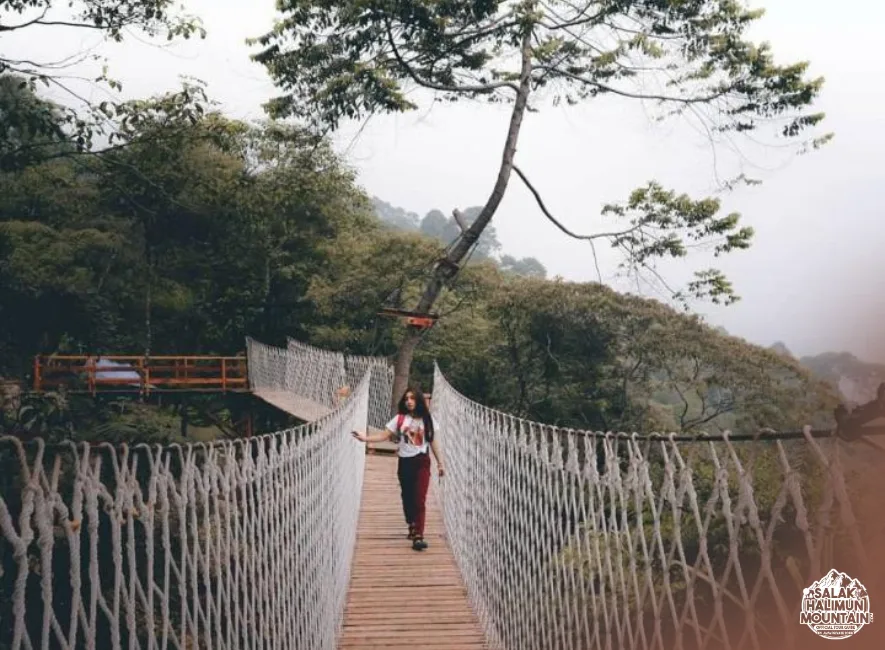
Unlike dramatic tourist structures built to impress from afar, this bridge blends into its surroundings. Wooden planks, steel cables, and modest railings are deliberately understated, allowing the forest to remain the main presence. As you step onto the bridge, the ground no longer feels solid beneath your feet. It responds subtly to each movement, reminding you that you are no longer walking through the forest but within it.
This canopy bridge exists not to dominate the landscape but to offer perspective. From here, the forest is not something you pass through. It is something that surrounds you completely.
The Moment Your Feet Leave the Ground
The first steps onto Jembatan Tajuk Cikaniki often come with a pause. Many visitors instinctively stop, grip the railing, and breathe. Below, the forest floor drops away into layered shadows. Above, branches weave into a dense ceiling of leaves, filtering sunlight into soft, shifting patterns.
The sensation is unlike hiking a trail or standing at a viewpoint. You are suspended. The bridge sways gently, not enough to frighten, but enough to make you aware of balance. Each step becomes intentional. Each movement is slower. In this space, rushing feels impossible and unnecessary.
As you move forward, the forest seems to rise to meet you. Ferns grow from tree trunks at eye level. Orchids cling quietly to bark, their roots exposed to air. Leaves glisten with droplets that fall occasionally, tapping softly against the wood beneath your feet.
Listening to the Forest from the Canopy
Sound behaves differently above the forest floor. On Jembatan Tajuk Cikaniki, the usual crunch of boots on soil is replaced by the hollow rhythm of footsteps on wood. Around you, the canopy hums with life.
Bird calls come from unexpected directions. Some are sharp and brief, others long and melodic. Insects buzz close by, then vanish into leaves. Wind passes through branches, producing a low rustling that feels almost like breathing.
Occasionally, the forest falls quiet for a few seconds. These pauses are not empty. They are filled with anticipation, as if the rainforest is listening back. Then, slowly, sound returns, layered and alive.
For many visitors, this auditory experience becomes one of the most memorable parts of the walk. It reveals how the forest communicates vertically, not just across the ground but through layers of height.
Light, Mist, and the Moving Canopy
In the rainforest, light is never constant. On Jembatan Tajuk Cikaniki, sunlight arrives in fragments, slipping through leaves and branches in narrow beams. As clouds move overhead, brightness shifts subtly, turning greens darker or suddenly luminous.
In the morning or after rain, mist often drifts through the canopy. It softens edges, blurs distance, and gives the forest an almost dreamlike quality. Water droplets cling to spider webs stretched between branches, catching light like fine threads of glass.
This play of light and moisture creates a sense of being inside a living system. The forest is not a backdrop. It is active, responsive, and constantly changing around you.
Life That Lives Above the Ground
Many people imagine rainforests as places where life happens on the ground. Walking across Jembatan Tajuk Cikaniki quietly challenges that idea. The canopy is its own world, home to countless species that may never touch the forest floor.
Epiphytes grow without soil, using trees only as support. Moss blankets branches, holding moisture and creating microhabitats for insects. Birds move swiftly between perches, while butterflies drift through patches of sunlight.
Even when animals remain unseen, their presence is felt. Chewed leaves, scattered seeds, and distant movement all hint at the constant activity happening just beyond human sight. From the bridge, visitors begin to understand that the rainforest is layered vertically, each level playing a crucial role in the whole.
Why Walking Above the Forest Changes Perspective
Walking above the forest alters more than just your physical position. It changes how you relate to nature. On the ground, humans often feel dominant, moving through space with confidence. In the canopy, that confidence softens into humility.
Here, trees are no longer background elements. They are towering structures that support entire ecosystems. Leaves are not just decoration. They are engines of life, capturing light and feeding the forest below.
This shift in perspective encourages reflection. Many visitors describe feeling calmer, more attentive, and more respectful of the environment. The experience slows the mind, inviting observation rather than consumption.
For photographers, the canopy offers rare angles and intimate details. For slow travelers, it provides a moment of stillness. For first-time visitors, it becomes a powerful introduction to the complexity of tropical rainforests.
An Experience Rooted in Conservation
Jembatan Tajuk Cikaniki is closely tied to conservation and education. It was developed not as an amusement attraction but as a tool for understanding forest ecosystems. By allowing people to experience the canopy without damaging it, the bridge helps build appreciation and care.
Visitors who walk this path often leave with a deeper awareness of how fragile and interconnected rainforest systems are. This awareness is essential in places like Halimun Salak, where conservation depends not only on regulations but on shared understanding.
Responsible behavior on the bridge is part of this ethic. Moving slowly, keeping noise low, and respecting wildlife ensures that the canopy remains a place of balance rather than disturbance.
A Memory That Stays Long After the Walk
Long after leaving Jembatan Tajuk Cikaniki, many visitors carry the experience with them. It appears in memories of filtered light, the gentle sway beneath their feet, and the quiet realization that forests are far more complex than they seem from below.
This is the power of canopy-level experiences. They do not overwhelm with spectacle. Instead, they invite connection. They teach without lecturing and inspire without demanding attention.
In Halimun Salak National Park, where mist and mountains shape daily life, walking above the forest offers a rare chance to see the rainforest as it truly is, alive in layers, patient, and deeply interconnected.
So, if you’re ready to explore the wonders of Mount Salak Halimun, head over to our ONLINE BOOKING PAGE and let’s start planning your adventure. Or simply CLICK THIS LINK to chat with us on WhatsApp.
With our team, you’re not just getting a guide; you’re gaining a local friend who will ensure your trip is nothing short of extraordinary.