salakhalimunmountain.com – deep inside the rainforest of Mount Salak, there are places where footsteps naturally slow and voices instinctively soften. The air feels heavier. The forest seems to listen. These are not places marked by fences or warning signs, yet for generations, locals have known to treat them with care. Kawah Ratu and Puncak Manik are among the most revered locations within Gunung Salak, not because of fear, but because of the powerful convergence of nature, history, and belief.
To walk toward these sites is to move through layers of meaning. Science explains their physical danger. Culture explains their spiritual weight. Together, they form a landscape that demands respect rather than conquest.
Mount Salak as a Landscape of Sacred Points
In Sundanese understanding, not all areas of a mountain carry the same energy. Certain points act as anchors, places where natural forces concentrate. Springs, craters, peaks, and old forest clearings are often regarded as nodes where the seen and unseen worlds touch.
Mount Salak, with its volcanic origins and fractured terrain, contains many such points. Over centuries, experience taught local communities where to tread lightly. Stories grew around these places, not to frighten, but to remind.
Kawah Ratu and Puncak Manik stand out because they embody this meeting of raw geological power and long-held cultural awareness.
Kawah Ratu and the Breath of the Earth
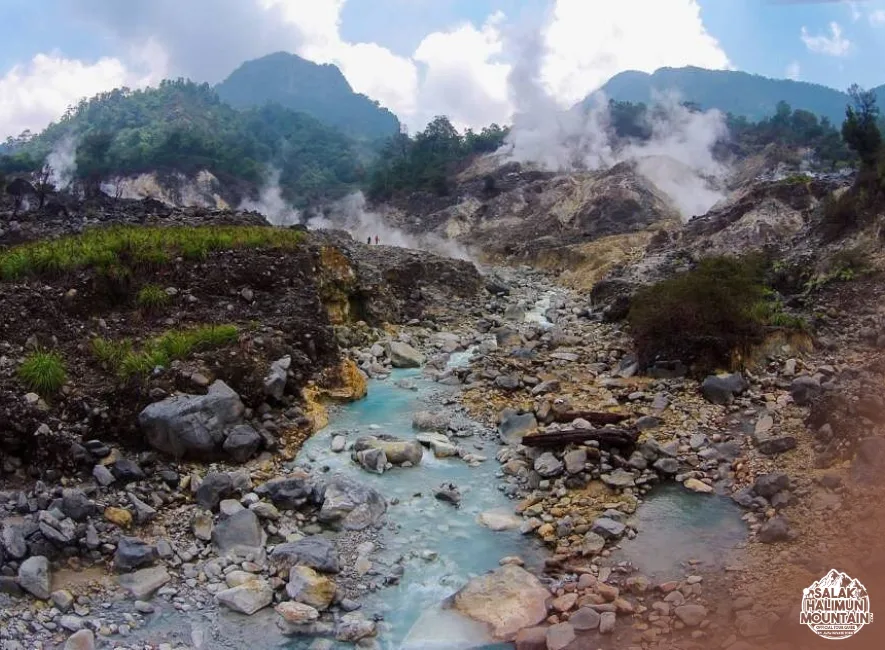
Kawah Ratu is one of the most striking volcanic features on Mount Salak. As trekkers approach, the forest gradually thins. The smell of sulfur becomes unmistakable. Steam rises from the ground, curling into the canopy like pale smoke.
Geologically, Kawah Ratu is an active volcanic crater. Sulfur gases seep continuously from underground vents. These gases can be toxic, especially in calm weather when they accumulate in low-lying areas. The ground around the crater is unstable, with thin crusts that can collapse under weight.
These facts are well understood by guides and locals. Yet long before modern geology explained sulfur emissions and volcanic gas, people already knew this place was dangerous. Cultural interpretation framed this danger as sacred warning.
Danger Interpreted as Sacred Signal
In Sundanese belief, nature does not harm without reason. When a place poses danger, it is seen as a message to maintain distance and humility. Kawah Ratu’s fumes are understood as the mountain exhaling, a reminder that humans are visitors.
This belief shaped behavior. Silence is observed near the crater. Movement is careful. Lingering is discouraged. These practices align perfectly with modern safety principles, showing how cultural wisdom often mirrors scientific reality.
Rather than treating Kawah Ratu as a spectacle, locals regard it as a living system that must be approached with awareness.
Puncak Manik as the Spiritual Center
If Kawah Ratu represents the volatile breath of the earth, Puncak Manik represents stillness. Known by many as the spiritual heart of Mount Salak, this peak is surrounded by dense forest and shifting mist.
Unlike dramatic volcanic craters, Puncak Manik does not announce itself loudly. Its intensity lies in quiet presence. Visibility here often drops suddenly. Sound becomes muffled. Many who reach this area describe a feeling of deep introspection.
In local belief, Puncak Manik is considered a central point, a place where spiritual currents converge. It is associated with meditation, reflection, and inner balance.
Why Silence Matters at Puncak Manik
Silence around Puncak Manik is not enforced through fear. It is encouraged through understanding. Loud voices are thought to disturb not spirits, but concentration. This peak is seen as a place where intention matters.
Visitors who approach with calm often report feeling grounded. Those who arrive carelessly may feel unsettled. Such experiences are interpreted as reflections of one’s own state rather than external threat.
From a practical perspective, silence also sharpens awareness. In thick fog and narrow trails, attentiveness can prevent accidents. Once again, cultural practice aligns with safety.
Sacred Graves and Keramat Sites in the Forest
Scattered across Mount Salak are old graves and keramat sites, often marked modestly with stones or cloth. These are not tourist attractions. They are places of remembrance and reverence.
Some are believed to belong to spiritual figures or guardians. Others commemorate individuals who chose to live close to the forest. Regardless of origin, these sites reinforce the idea that Mount Salak has long been inhabited, not just physically, but spiritually.
Respecting these sites means not touching offerings, not taking photographs without understanding, and maintaining quiet presence.
Why Certain Places Demand Respect
Not every part of the mountain requires the same behavior. Places like Kawah Ratu and Puncak Manik demand heightened awareness because they concentrate risk, meaning, or both.
In Sundanese cosmology, respect is shown through restraint. Knowing when not to approach too closely is a form of wisdom. These teachings prevented countless accidents long before warning signs existed.
Modern trekkers benefit greatly from understanding this context. What may appear as myth is often a refined system of environmental ethics.
Science and Belief Walking Together
Mount Salak demonstrates how scientific explanation and cultural belief can coexist without conflict. Sulfur gas explains physical danger. Myth explains behavioral response. Both aim to protect life.
By recognizing Kawah Ratu as both a volcanic hazard and a sacred site, visitors learn to treat nature with seriousness. By approaching Puncak Manik as both a geographical point and a spiritual center, they learn to move with intention.
This integrated understanding is what allows Mount Salak to remain accessible yet protected.
Experiencing Sacred Places Responsibly
Visiting these locations should never be rushed. Proper guidance, weather awareness, and respect for local customs are essential. These practices ensure safety while honoring tradition.
Walking through Mount Salak is not about collecting locations. It is about understanding relationships between land, people, and belief.
Listening to the Mountain
Kawah Ratu and Puncak Manik teach different lessons. One reminds us of nature’s raw power. The other invites inner stillness. Together, they shape Mount Salak’s identity as a sacred landscape rather than a haunted one.
Those who listen carefully often leave with more than memories. They leave with perspective.
So, if you’re ready to explore the wonders of Mount Salak Halimun, head over to our ONLINE BOOKING PAGE and let’s start planning your adventure. Or simply CLICK THIS LINK to chat with us on WhatsApp.
With our team, you’re not just getting a guide; you’re gaining a local friend who will ensure your trip is nothing short of extraordinary.