salakhalimunmountain.com – The Cibalay Site is now recognized as one of the most significant prehistoric cultural discoveries in West Java. Hidden deep within the rainforest of Mount Salak, this ancient sacred landscape continues to reveal layers of history that reshape our understanding of early civilization in Java.
Located in Desa Tapos I, Tenjolaya District, Bogor Regency, approximately 24 kilometers from Cibinong, the site lies inside the protected forest of Gunung Halimun Salak National Park. Recent archaeological research has uncovered extensive terraced stone structures, standing stones, ritual altars, and pathways believed to be used for ancestral worship thousands of years ago.
A Major Archaeological Discovery in the Heart of Mount Salak
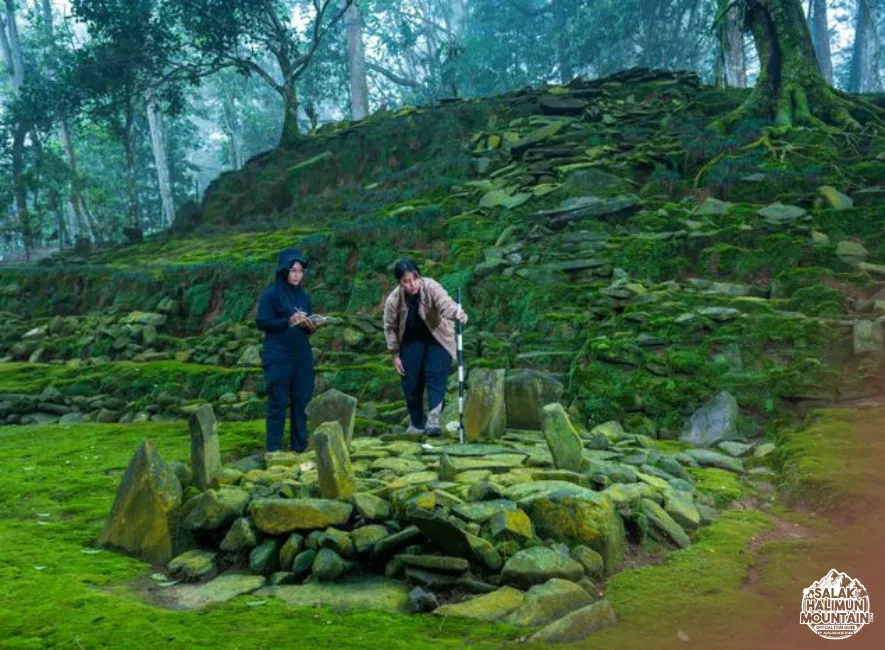
A joint team of archaeologists, academics, students, and government institutions recently completed an intensive delineation program at the Cibalay Site. Despite challenging terrain, dense vegetation, and frequent rainfall, the team successfully identified 38 potential cultural heritage points, five of which have already been officially designated as protected cultural heritage by local authorities.
Among the most remarkable discoveries were large stone terraces, menhirs, and flat altar stones. These features strongly indicate that Cibalay functioned as a major ritual complex dedicated to ancestral reverence and spiritual practices.
Punden Berundak: The Oldest Sacred Architecture in Java
The Cibalay Site is classified as a punden berundak, a stepped terraced structure dating back to the Neolithic period, around 2500–1500 BCE. Punden berundak are widely regarded as the earliest form of sacred architecture in the Indonesian archipelago and are considered the conceptual predecessors of later Hindu-Buddhist temples.
Structurally, the site consists of multiple open terraces arranged in ascending levels. Stone walls, stairways, floors, and upright stones define each space. Unlike other sites that use columnar stone formations, Cibalay’s builders adapted thin, flat stones to follow the natural contours of the land.

Name, Meaning, and Austronesian Heritage
The name Cibalay derives from the Sundanese word babalay, meaning stones arranged for specific functions such as pathways or structures. Archaeological interpretation suggests that punden berundak were built by early Austronesian communities as part of rituals honoring ancestral spirits.
Similar structures found across Java strengthen the theory that these terraced sanctuaries formed the spiritual foundation upon which later monumental temple architecture developed.
Living Traditions That Never Disappeared
What makes Cibalay exceptional is that its sacred role has never truly vanished. Local communities still regard the area as spiritually important. Elders recall ritual visits involving prayers, offerings, and communal meals before agricultural cycles.
This continuity demonstrates that Cibalay is not merely an archaeological relic, but a living cultural landscape where ancient beliefs quietly persist alongside modern life.

Delineation and Cultural Preservation
The delineation process is part of a broader effort to protect Cibalay as a cultural heritage zone while integrating it into Bogor Regency’s geopark program. Mapping cultural boundaries ensures that preservation, research, and limited educational use can coexist with forest conservation.
Interdisciplinary collaboration played a key role, combining archaeology, geodesy, and visual documentation. The final mapping covers more than 62 hectares of culturally significant terrain.
Highland Terraces and Monumental Findings
One of the most impressive sites documented during the research is Pasir Manggis, located at nearly 1,000 meters above sea level. This massive terraced structure consists of seven levels with multiple standing stones arranged for ritual use.
Even more striking was the discovery of a large punden berundak with at least ten terraces rising nearly 20 meters. Uniquely, it is located in a valley rather than on a ridge, indicating sophisticated landscape modification by prehistoric builders.
Water, Ritual, and Sacred Geography
Many of the newly identified terraces are located near natural springs. Water played a crucial role in ritual purification and often marked the boundary between sacred and non-sacred space.
This relationship between stone structures, water sources, and mountain terrain highlights how ancient societies adapted their spiritual practices directly to Mount Salak’s natural environment.
Mount Salak as a Layered Cultural Landscape
The discoveries at Cibalay confirm that Mount Salak is far more than a volcanic massif or trekking destination. It is a layered cultural landscape where prehistoric spirituality, living traditions, and protected rainforest ecosystems coexist.
For travelers interested in archaeology, culture, and deep history, Mount Salak offers one of the most meaningful off-the-beaten-path experiences in West Java.
Exploring Mount Salak Responsibly
Due to its sensitive cultural and ecological status, access to Mount Salak’s hidden heritage requires careful guidance. Through private and responsible experiences, Java Private Tour provides opportunities to explore Mount Salak while respecting its natural and cultural integrity.
If you are ready to explore the deeper story of Mount Salak, visit our ONLINE BOOKING PAGE or CLICK HERE TO CHAT ON WHATSAPP.
With Java Private Tour, you are not just visiting a mountain — you are stepping into one of Java’s oldest living stories.
See you in Mount Salak.