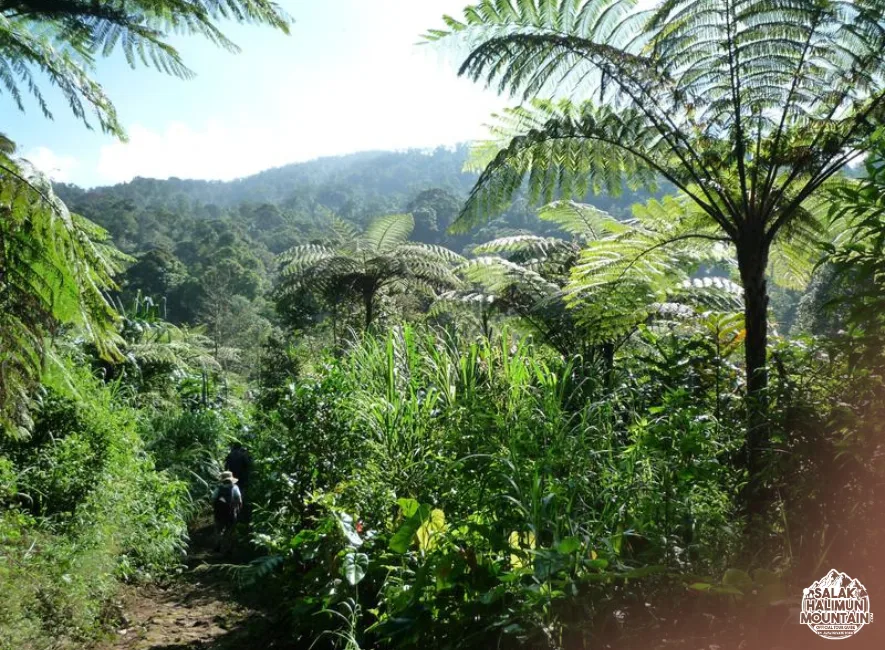
salakhalimunmountain.com – If you walk quietly into Salak Halimun National Park just after dawn, you will feel it before you understand it. The air is thick with moisture. Cicadas pulse in steady rhythm. A river murmurs somewhere below the trail, hidden behind curtains of fern and bamboo. Above you, layers of green stretch endlessly — moss-draped branches, towering rasamala trees, and a canopy so dense that sunlight arrives only in scattered beams.
This is not just a forest. This is one of the most important biodiversity strongholds left on the island of Java. Salak–Halimun National Park — often called the lungs of western Java — is where life still thrives in remarkable abundance. From microscopic soil organisms to endangered primates swinging through the treetops, biodiversity here is not accidental. It is the result of geography, climate, history, and careful conservation woven together into one living system. Let’s walk deeper into the forest and explore why biodiversity continues to flourish here.
A Vast Rainforest in a Densely Populated Island
Java is one of the most densely populated islands on Earth. Cities, farms, highways, and settlements have replaced much of its original forest. In this landscape of fragmentation, Salak–Halimun National Park stands out as something rare and precious: a large, continuous block of tropical rainforest.
Covering more than 113,000 hectares, the park connects Mount Salak and Mount Halimuninto one vast protected area. This size matters. Large forests can support complete ecosystems — predators, prey, pollinators, decomposers — all interacting in balance.
Smaller forest patches often lose sensitive species first. But here, deep in Salak–Halimun, animals still have space to roam, plants can regenerate naturally, and ecological processes continue uninterrupted.
Altitudinal Gradients That Create Many Worlds in One Park
One of the most powerful reasons biodiversity thrives here is something you feel with every step uphill: altitude.
Salak–Halimun National Park stretches from lowland forests around 500 meters above sea level to montane zones rising beyond 2,200 meters. Each elevation creates a different climate, different vegetation, and different communities of life.
Lowland and Colline Forests
In the lower elevations, the forest feels warmer and heavier. The air hums with insects. Large-leafed plants, palms, and lianas dominate the understory. These zones support rich insect life, amphibians, reptiles, and many bird species that thrive in warm, humid conditions.
Submontane Forests
Climb higher, and the forest changes. The temperature drops slightly. Moss begins to creep across rocks and tree trunks. Tree species shift — puspa and rasamala become more common. This zone is especially important for mammals and birds that need cooler temperatures and dense canopy cover.
Montane Forests
At higher elevations, clouds often wrap the forest in mist. Trees grow shorter but denser. Epiphytes — orchids, mosses, and ferns — flourish. This is prime habitat for endemic species adapted to cooler, wetter conditions found nowhere else.
Because of this vertical diversity, Salak–Halimun is not one ecosystem, but many ecosystems stacked together, each supporting different life forms.
Rich Vegetation as the Foundation of Life
Biodiversity begins with plants — and Salak–Halimun is extraordinarily rich in them.
The park hosts hundreds of plant species, many of them endemic to Java or Indonesia. These plants create food, shelter, nesting sites, and microhabitats for countless animals.
Towering Forest Giants
Trees like Rasamala (Altingia excelsa) and Puspa (Schima wallichii) dominate many areas. These giants regulate temperature, retain moisture, stabilize soil, and create the vertical structure essential for birds, primates, and insects.
Orchids, Ferns, and Understory Life
Hidden among branches and forest floors are delicate orchids, bird’s nest ferns (Asplenium nidus), rattan, and medicinal plants used by local communities for generations.
Continuous Food Supply
Because different plants flower and fruit at different times, the forest provides year-round food availability. This stability supports animals like birds, bats, and primates, reducing seasonal stress and increasing survival rates.
Ecological Corridors That Keep Wildlife Connected
One of the most critical conservation achievements in Salak–Halimun National Park is the ecological corridor connecting Mount Salak and Mount Halimun.
This corridor allows animals to move freely between habitats — searching for food, mates, and new territories. In fragmented landscapes, isolation leads to inbreeding and population decline.
On an island where forests are often cut into isolated fragments, Salak–Halimun functions as a living bridge for biodiversity.
A Refuge for Endangered and Endemic Wildlife
Step quietly through the forest, and you may hear one of Java’s most haunting sounds: the long, echoing call of the Javan gibbon.
The Javan Gibbon Sanctuary
Salak–Halimun National Park is one of the last strongholds for the endangered Javan gibbon. These primates depend on tall, continuous canopy forests and stable food sources — conditions increasingly rare outside protected areas.
Other Wildlife Residents
- Javan leopard
- Ebony leaf monkey
- Sunda pangolin
- Hundreds of bird species
- Amphibians sensitive to water quality
- Countless insects and pollinators
The Invisible Life Beneath Your Feet
Biodiversity is not only what you see — it is also what lives beneath the leaf litter.
The forest floor is alive with soil arthropods, fungi, bacteria, and microorganisms. These unseen workers decompose fallen leaves, recycle nutrients, and enrich the soil that feeds the entire forest.
A Vital Water Catchment for Western Java
Rivers born in Salak–Halimun flow outward to communities far beyond the park’s boundaries. The forest acts as a natural sponge — absorbing rainfall, releasing it slowly, and preventing floods and erosion.
Local Communities as Part of the Ecosystem
Indigenous and local communities have lived around Salak–Halimun for generations, developing deep knowledge of the forest. Responsible trekking and community-based tourism help ensure that biodiversity protection and livelihoods grow together.
Walking Into a Living Web of Life
To explore Salak–Halimun is to walk inside a living system where everything connects: soil to tree, tree to bird, bird to river, river to village. Biodiversity thrives here because the forest is allowed to breathe, stretch, and renew itself — from the lowlands to the misty peaks.
So, if you’re ready to explore the wonders of Mount Salak–Halimun, head over to our ONLINE BOOKING PAGE and let’s start planning your adventure. Or simply CLICK THIS LINK to chat with us on WhatsApp.
With our team, you’re not just getting a guide; you’re gaining a local friend who will ensure your trip is nothing short of extraordinary.